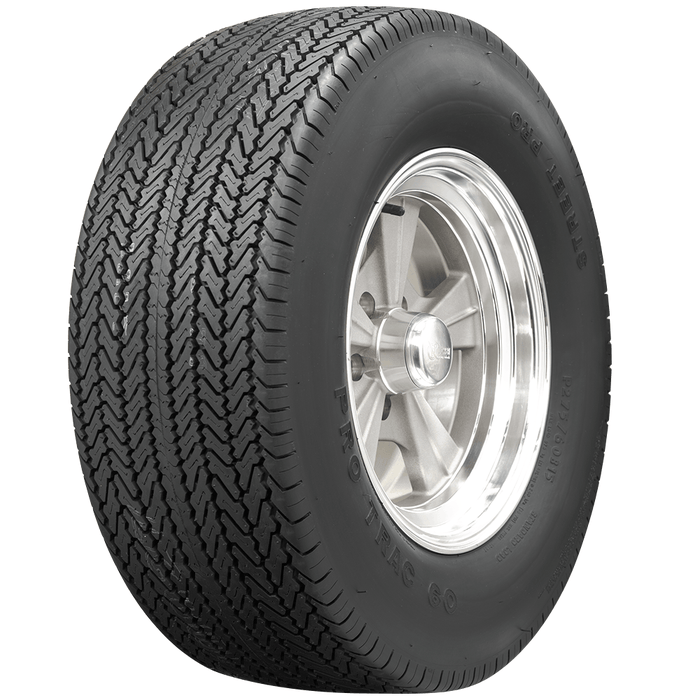

235/60-15 Street Pro Blackwall Tire
Pro Trac tires are perfect for your Pro Street, street machine or hot rod, thanks to a super wide profile that offers the race ready look without the safety concerns of driving on the street with actual racing slicks. Protrac tires are DOT approved, bias ply tires and they're perfect for a car that is mini-tubbed. The tread pattern has been thoroughly tested to ensure safety in dry and wet conditions. Street machines are making a big comeback, so put your ride back on the road with a new set of BIG Pro-Trac tires. Check out the front runners, too!
Blackwall Tire
Since the introduction of carbon black rocked the tire industry, the original recipe for most tires has been a solid black sidewall. For classics and collector cars alike, it's hard to beat the no-nonsense appeal of a classic blackwall style tire. British sports car, classic truck and even hot rod enthusiasts love the way a nice period correct blackwall tire looks on their vehicles.
Bias Ply Construction
Bias ply tire construction is a method that was used from the 1900's through the 1970's on passenger cars and light trucks. Bias ply tires feature ply cords that run at a 45 degree angle to the bead, and overlap in a crisscross pattern, depending on how many ply layers are used. This creates a strong tire, but bias ply tires have a tendency to follow breaks or ruts in the pavement. Bias ply tires are the most authentic choice for classic car restorations and traditional hot rod builds. Coker Tire offers a huge variety of bias ply tires for many applications.
Pro-Trac Street Pro Tires
Take a trip back to the 1970’s with Pro Trac Street Pro tires. These iconic bias ply tires feature custom sizing to fit ‘70s street machines and Pro Street builds. With skinny front runners and giant rear tires, there are plenty of options to get your old school combination rolling.
Pro-Trac- Brand Tires
The iconic Pro-Trac brand bias Ply tires were born on ‘70s street machines and Pro Street builds. Famously a groovy day Two option for serious enthusiasts of the era. The brand now offers both original bias ply fitments and innovative new ultra-high performance radials with all of the classic day two style that made the brand a street legend.
Please Note
- Tire mounted on wheel for demonstration purposes only. Wheel and other accessories are not included. Please note that dimensions listed (tread width, section width and overall diameter) are non-scientific and based on an inflated tire, mounted to a wheel. Dimensions may vary due to rim width and inflation pressure.
| SKU | 72000 |
|---|---|
| Weight | 31.000000 |
| Construction Ply | POLY/FIBERGLASS |
| Brand | Pro-Trac |
| Drag Tire Type | Street | DOT |
| Tube Type or Tubeless | Tubeless |
| Tire Series | Street Pro |
| Tire Construction | Bias Ply |
| Rim Diameter | 15 inch |
| Width Radial | 235 mm |
| Sidewall Style | Blackwall |
| Width Bias Ply | 235/60 |
| Product Size | 235/60-15 |
| GTIN | 00842199100952 |
| Section Width (IN) | 9.7 |
| Rim Width (in) | 6.50 - 8.00 |
| Overall Diameter (IN) | 26.65 |
| Availability Date | 2026-11-30T00:00:00Z |
This Pro-Trac Street Pro comes in the 235/60-15 size, suitable for the classic and collector vehicles listed below.
About the 235/60-15 Tire Size
The 235/60-15 tire size is the size associated with this Pro-Trac Street Pro, giving shoppers a clear fitment reference when matching a tire to period-style vehicle applications. In this product, that size is paired with a bias ply construction, making the 235/60-15 designation the key starting point for comparing related vehicle applications and navigating fitment research. For more detailed information on this tire size, explore the 235/60-15 tire on Coker Tire Fitment Guide.
Frequently Asked Questions
Purchase Considerations ▼
Is the Pro-Trac Street Pro 235/60-15 better suited to the rear axle than the front? ▼
The Pro-Trac Street Pro 235/60-15 may be suitable for a rear axle setup when its dimensions and load capacity match the vehicle's requirements. The 235/60-15 size indicates a nominal section width of 235 mm, a 60-series aspect ratio, and a 15-inch wheel diameter. These dimensions influence the tire's overall diameter, sidewall height, and clearance. Whether it belongs on the rear axle depends on the vehicle's original specifications, wheel width, suspension geometry, and intended use rather than the tire size alone.
Before fitting the Pro-Trac Street Pro 235/60-15 to the rear, compare its overall diameter and width with the front tire setup and check clearance around the fenders and suspension. A wider rear tire can affect steering balance and vehicle behavior when paired with narrower front tires. Verify load requirements, wheel compatibility, and any manufacturer restrictions before choosing a staggered setup. The product's suitability for a particular axle should be confirmed against the vehicle's specifications.
Will the Pro-Trac Street Pro 235/60-15 require changes to my wheel offset? ▼
The Pro-Trac Street Pro 235/60-15 does not automatically require a wheel offset change. Compatibility depends on your existing wheel dimensions, backspacing, suspension configuration, and available space inside the wheel opening. The tire's nominal 235 mm section width and 60-series aspect ratio influence how much room it needs, but the mounted dimensions can vary with rim width and inflation pressure. A tire that fits the wheel diameter may still interfere with suspension components or the fender if the offset and backspacing are unsuitable.
Before changing wheel offset, measure the available clearance on both sides of the tire and check for interference during steering and suspension compression. Moving a wheel outward can increase fender interference, while moving it inward can reduce clearance near suspension components. Confirm that the wheel width is suitable for the tire and that any proposed offset change preserves safe wheel positioning. Check the complete setup before installation rather than assuming a different offset is necessary.
Is the Pro-Trac Street Pro 235/60-15 suitable for a car that will see both shows and regular driving? ▼
The Pro-Trac Street Pro 235/60-15 may suit a car that attends shows and is also driven, provided the tire's specifications match the vehicle and its intended use. The Pro-Trac Street Pro line is associated with classic street machines, hot rods, and Pro Street builds, making it relevant to owners seeking a period-inspired appearance. The 235/60-15 size provides a relatively substantial sidewall profile, but the actual stance depends on wheel dimensions, suspension height, and the tire's mounted diameter.
For regular driving, verify the specific tire's construction, load capacity, speed rating, and road-use suitability before purchasing. These details matter because show-oriented appearance alone does not establish suitability for highway use. Check inflation requirements and inspect clearance around the fenders and suspension, especially if the car has been modified. If the vehicle uses different front and rear tire sizes, confirm that the combination is appropriate for its handling characteristics. A qualified tire professional can help verify the complete setup.
Is the Pro-Trac Street Pro 235/60-15 a practical choice for a modified Pro Street vehicle? ▼
The Pro-Trac Street Pro 235/60-15 may be worth considering for a modified Pro Street vehicle when the goal is to retain a classic street-machine appearance. The 235/60-15 sizing combines a nominal 235 mm section width with a 60-series aspect ratio and a 15-inch wheel diameter. These dimensions influence the tire's overall diameter, sidewall height, and relationship to the wheel opening. However, suitability depends on the specific vehicle configuration rather than the Pro Street designation alone.
Before purchasing, confirm wheel width, offset, backspacing, load requirements, and clearance throughout suspension travel. Modifications such as lowered suspension, altered wheel tubs, or changes to the rear axle can affect fitment. Also verify the exact product's construction, speed rating, and suitability for the vehicle's intended driving conditions. Changes in tire diameter can affect speedometer accuracy and effective gearing, while tire width and construction can influence steering and handling. Confirm these details before installation to avoid fitment and usability problems.
Fitment & Compatibility ▼
Will the Pro-Trac Street Pro 235/60-15 fit my 15-inch wheel setup? ▼
The Pro-Trac Street Pro 235/60-15 is built specifically for 15-inch wheels and should only be mounted on that diameter. The listed approved rim width range is 6.50 to 8.00 inches, so buyers should confirm actual wheel width before ordering. Staying inside that range helps preserve tread shape, sidewall stability, and predictable road manners.
The tire also measures 9.7 inches in section width and 26.65 inches in overall diameter. Buyers should verify clearance at fenders, frame rails, springs, and suspension arms with the vehicle loaded. Turning clearance matters on front applications. Correct fitment depends on wheel diameter, wheel width, and available vehicle space together.
Will the Pro-Trac Street Pro 235/60-15 fit the same as a modern radial 235/60-15? ▼
Not necessarily. Matching sidewall numbers help comparison, but bias ply and radial tires can differ in mounted profile, tread contour, and sidewall shape. The Pro-Trac Street Pro 235/60-15 may appear different from a modern radial labeled with the same size.
Construction also affects how the tire settles under vehicle weight. Buyers switching from radials should use actual dimensions and clearance measurements rather than assuming every 235/60-15 installs identically. Checking real numbers first reduces surprises involving rubbing, stance, or steering feel after installation.
Tire Size Equivalents & Conversions ▼
What older tire sizes does the Pro-Trac Street Pro 235/60-15 replace? ▼
The product page lists the Pro-Trac Street Pro 235/60-15 as a suitable radial replacement reference for an F60-15 bias ply tire. That makes the size useful for owners replacing older muscle car or street machine fitments while staying near a familiar footprint.
Replacement references should be treated as a starting point rather than an automatic guarantee. Wheel width, ride height, suspension changes, and wheel offset all affect final fitment. Buyers should compare actual dimensions and available space before ordering instead of relying only on historical size charts.
Is the Pro-Trac Street Pro 235/60-15 similar to an FR60-15? ▼
Yes, the product page identifies FR60-15 as a similar size radial alternative. That helps buyers who know vintage sizing systems translate the Pro-Trac Street Pro 235/60-15 into a familiar range for diameter and overall footprint.
Comparable size does not mean identical behavior. The Street Pro remains a bias ply tire, so ride quality, tracking response, and sidewall feel can differ from a radial FR60-15 style product. Buyers should compare both dimensions and driving expectations before deciding between construction types.
Can the Pro-Trac Street Pro 235/60-15 be used with smaller front runner tires? ▼
Yes, staggered combinations are common on street machine builds. The product page even references front runners, showing that a narrower front tire paired with a wider rear tire is part of the intended style formula.
The important step is evaluating front and rear diameters together. Extreme differences can affect rake, braking balance, and visual proportion. Buyers should select the full set as a package rather than choosing front and rear tires independently for the best stance and drivability.
Performance & Use Case ▼
How will the Pro-Trac Street Pro 235/60-15 drive on normal roads? ▼
The Pro-Trac Street Pro 235/60-15 is intended for street use and is DOT approved, so it is designed for real road driving rather than trailer-only display use. The tread pattern is described as tested for dry and wet conditions, which supports everyday cruising and weekend driving.
Because the tire uses bias ply construction, road feel can differ from a modern radial. Buyers may notice more sensitivity to pavement grooves, seams, and road crown. Many enthusiasts accept that character as part of the vintage driving experience, but expectations should match the construction type.
How does the Pro-Trac Street Pro 235/60-15 feel compared with a radial tire? ▼
Most buyers notice a more traditional, connected feel rather than the filtered response of many modern radials. Bias ply construction can react differently to road grooves, steering inputs, and surface changes, which gives the vehicle an older-school personality many enthusiasts actively want.
The trade-off is that some drivers prefer the calmer straight-line behavior and sharper consistency of radials. Neither feel is automatically better because the right choice depends on goals. Buyers focused on nostalgia often enjoy the character, while high-mileage drivers may prefer radial refinement.
How does the Pro-Trac Street Pro 235/60-15 behave at higher speeds? ▼
Properly maintained tires can operate confidently within their intended use, but higher-speed behavior depends on alignment, balance, suspension health, and inflation accuracy. A bias ply tire may communicate more movement and road texture than a modern radial as speed rises.
Heat buildup also matters during sustained highway use, especially in hot weather or under heavy loads. Buyers should inspect tire condition regularly, maintain correct pressure, and avoid assuming any vintage-style tire behaves like a modern ultra-high-performance radial. Preparation makes a major difference.
Construction, Durability & Load Capacity ▼
How durable is the Pro-Trac Street Pro 235/60-15 for weekend use? ▼
For seasonal cruising, local events, and hobby driving, the Pro-Trac Street Pro 235/60-15 can be a practical option when maintained correctly. Proper inflation, alignment, storage, and rotation habits all support service life more than marketing claims alone.
Durability always depends on use pattern. Burnouts, aggressive launches, poor alignment, and long underinflated highway runs shorten tire life quickly. Buyers who treat the tire as a performance-oriented hobby product and maintain it consistently usually see better long-term results than neglectful owners.
Is the Pro-Trac Street Pro 235/60-15 suitable for heavier classic cars? ▼
Suitability depends on the actual vehicle weight, weight distribution, and intended use. Buyers should always match tire choice to the demands of the vehicle rather than assuming every wide tire suits every heavy car automatically.
Heavier vehicles place greater demands on pressure management, suspension condition, and heat control. Even when a size physically fits, correct setup remains essential. Buyers with large full-size classics or loaded cruisers should evaluate the complete vehicle package before selecting any tire.
Installation & Maintenance ▼
What wheel width should be used with the Pro-Trac Street Pro 235/60-15? ▼
The product page lists an approved rim width range of 6.50 to 8.00 inches. Staying inside that range helps the Pro-Trac Street Pro 235/60-15 maintain its intended tread shape, sidewall profile, and road behavior after installation.
A narrow wheel can pinch the tire and alter contact patch shape, while an overly wide wheel can stretch the sidewalls and change support characteristics. Buyers should verify actual measured wheel width before ordering rather than relying on guesses or nominal descriptions.
Does the Pro-Trac Street Pro 235/60-15 require tubes? ▼
The product page identifies the Pro-Trac Street Pro 235/60-15 as tubeless. On a compatible tubeless wheel in good condition, a tube is typically not required. That simplifies installation and routine maintenance for many buyers.
Wheel condition still matters greatly. Damaged bead seats, rust, or sealing problems can cause air loss regardless of tire type. Buyers using older wheels should inspect and refurbish wheels when necessary before mounting a new tire for the best sealing performance.
How often should the Pro-Trac Street Pro 235/60-15 air pressure be checked? ▼
Monthly checks are a smart minimum for regularly driven vehicles, and pressure should also be checked before long trips or after seasonal storage. Tires naturally lose pressure over time, and temperature changes can alter readings significantly.
Cold-pressure checks provide the most consistent baseline because heat from driving raises pressure temporarily. Buyers who drive collector cars infrequently should be especially diligent, since long parked periods can hide slow leaks until the next outing. Routine checks are simple and valuable.
Write Your Own Review
OTHER STUFF YOU MAY LIKE
Check items to add to the cart or