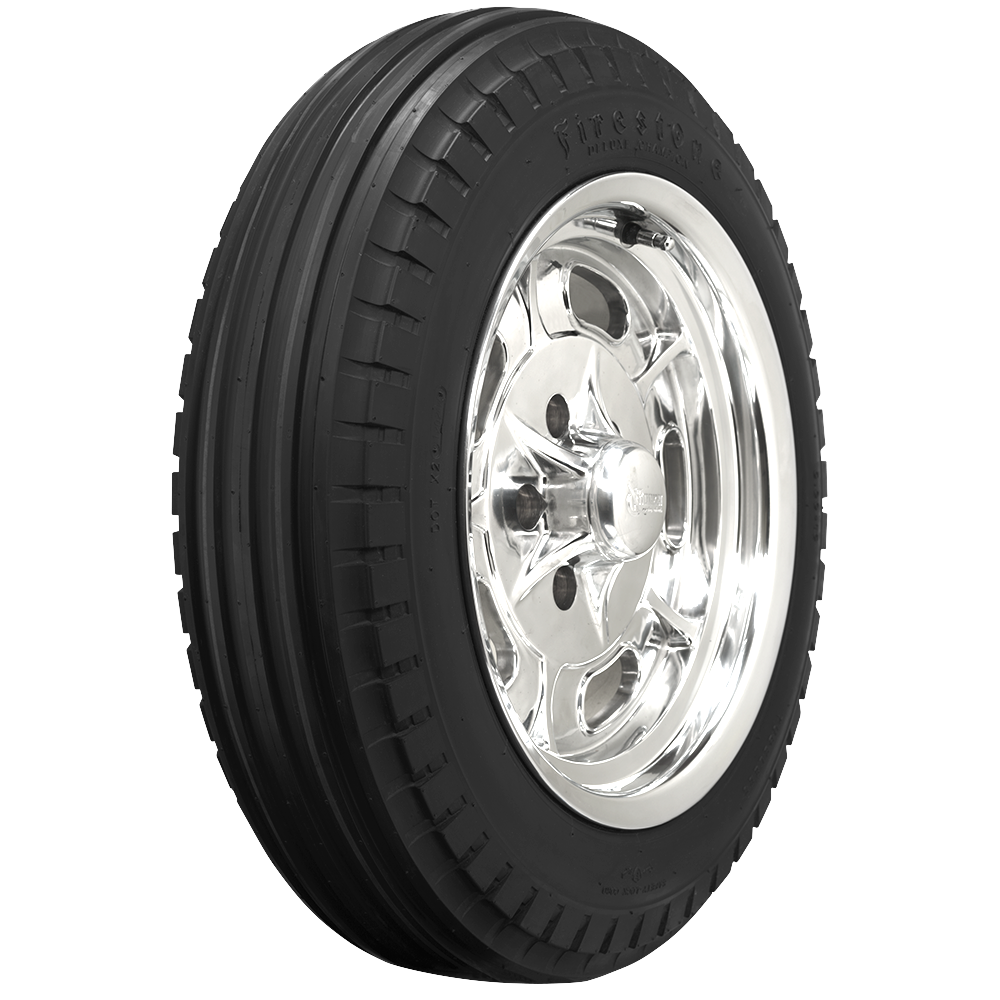
500-15 Silvertown Blackwall Tire
These classic blackwall BFGoodrich bias ply tires feature authentic tread design and nice sidewall details. These tires are hand-built in the USA using the original molds and traditional bias ply construction. The rubber compounds are modern and the quality is excellent. These tires feature fantastic period-correct styling and are available in many sizes for 10- to 15-inch fitments.
Blackwall Tire
Since the introduction of carbon black rocked the tire industry, the original recipe for most tires has been a solid black sidewall. For classics and collector cars alike, it's hard to beat the no-nonsense appeal of a classic blackwall style tire. British sports car, classic truck and even hot rod enthusiasts love the way a nice period correct blackwall tire looks on their vehicles.
Bias Ply Construction
Bias ply tire construction is a method that was used from the 1900's through the 1970's on passenger cars and light trucks. Bias ply tires feature ply cords that run at a 45 degree angle to the bead, and overlap in a crisscross pattern, depending on how many ply layers are used. This creates a strong tire, but bias ply tires have a tendency to follow breaks or ruts in the pavement. Bias ply tires are the most authentic choice for classic car restorations and traditional hot rod builds. Coker Tire offers a huge variety of bias ply tires for many applications.
BFGoodrich Silvertown Classic Bias Ply Tires
B.F.Goodrich Silvertown classic bias ply tires are available in dozens of sizes and styles to fit many antique and classic cars from the 1920’s through the 1970’s. With authentic designs and high quality construction, this product line is a favorite among car and truck restorers.
BFGoodrich Tires | 100 Years of Outstanding Tire Fitments
Coker Tire is proud to offer a 100-year range of fitment, thanks to a huge variety of BFGoodrich tires. From the early 1900's to the modern era, the BFG product lines offer original fitments and custom sizes for hot rods, classic trucks and more. We offer BFGoodrich tires in authentic bias ply construction, as well as modern radials. Also included in the BFG line are the famous Silvertowns, Radial T/A, Phenom and All Terrain T/A KO2 tires. You won't find a more comprehensive tire product line in the world!
Please Note
- Tire mounted on wheel for demonstration purposes only. Wheel and other accessories are not included. Please note that dimensions listed (tread width, section width and overall diameter) are non-scientific and based on an inflated tire, mounted to a wheel. Dimensions may vary due to rim width and inflation pressure. Please note Chemical Guys Tire and Rubber Cleaner and Adams Polish Tire shine has been linked to Whitewall browning and should not be used. We recommend using our line of tire care products.
| SKU | 55610 |
|---|---|
| Weight | 14.000000 |
| GTIN | 00842199105179 |
| Availability Date | 2026-06-15T00:00:00Z |
| Sidewall Style | Blackwall |
| Tire Construction | Bias Ply |
| Construction Ply | 4 PLY POLY |
| Tire Series | Silvertown Classic Bias Ply |
| Rim Diameter | 15 inch |
| Tube Type or Tubeless | Tubeless |
| Product Size | 500-15 |
| Tread Depth (32nds) | 12 |
| Tread Width (IN) | 4.00 |
| Width Bias Ply | 5.00 |
| Brand | BFGoodrich |
| Max Load Capacity (LBS) | 700@32 psi |
| Section Width (IN) | 5.10 |
| Rim Width (in) | 3 |
| Overall Diameter (IN) | 24.38 |
This BFGoodrich comes in the 500-15 size, suitable for the classic and collector vehicles listed below.
About the 500-15 Tire Size
The 500-15 tire size is associated with a select group of small-displacement classic vehicle applications spanning 1953 through 1960, including models from Hillman, Lloyd, Lotus, Morgan, Nissan, and Saab. This BFGoodrich is offered in the 500-15 size, and the product's bias ply construction makes it relevant to shoppers looking at period-style fitment for vehicles associated with this size. For more detailed information on this tire size, explore the 500-15 tire on Coker Tire Fitment Guide.
Vehicle Fitment for the BFGoodrich | 500-15
The BFGoodrich | 500-15 is available in a tire size associated with a range of classic and collector vehicles. The vehicle applications below are organized by year, make, and model to help identify vehicles associated with the 500-15 size. Explore the linked Make & Model and Year Make & Model pages for more detailed fitment information.
Fitment information should be verified for the specific vehicle before purchase. Confirm tire size, wheel fit, load requirements, overall diameter, and available clearance.
1951–19553 makes · 7 fitments
The 1951–1955 period includes 500-15 applications across Hillman, Lloyd, and Saab. These vehicle associations center on a compact group of mid-1950s models tied to this tire size.
Hillman
Hillman applications in this period include the Husky.
Lloyd
Lloyd fitment in this period is represented by the LT.
Saab
Saab fitment in this period is represented by the Saab 92.
1956–19607 makes · 9 fitments
The 1956–1960 period expands 500-15 applications across Hillman, Lloyd, Saab, Lotus, Morgan, and Nissan. This range covers a broader mix of vehicles associated with the 500-15 size.
Hillman
Hillman applications in this period include the Husky.
Lloyd
Lloyd fitment in this period is represented by the LT.
Lotus
Lotus fitment in this period is represented by All Models.
Morgan
Morgan fitment in this period is represented by the Series.
Nissan
Nissan fitment in this period is represented by the 211 Series.
Saab
Saab fitment in this period is represented by the Saab 92.
Frequently Asked Questions
Fitment & Compatibility ▼
Will the BFGoodrich 500-15 Silvertown Blackwall Tire fit my original 15-inch wheels? ▼
The BFGoodrich 500-15 Silvertown Blackwall Tire is built for a 15-inch rim diameter and lists a 3-inch rim width, which is very narrow by modern standards. Many early imported cars, small British sports cars, and compact classics used narrow wheels, so factory steel wheels are often the best match. Verifying wheel width before purchase matters more than bolt pattern alone.
A wider aftermarket wheel can alter sidewall shape, tread profile, and handling feel. Stretching a narrow bias ply tire onto a wider rim may reduce period-correct appearance and can change how the contact patch sits on the road. Measuring current wheel width bead-to-bead is the safest first step before ordering.
How will the BFGoodrich 500-15 Silvertown Blackwall Tire affect steering effort at low speeds? ▼
The BFGoodrich 500-15 Silvertown Blackwall Tire uses a narrow tread and section width, so parking-lot steering effort is usually lighter than with wider replacement tires. Manual-steering classics often feel easier to maneuver when front tires remain close to original narrow dimensions. That can be especially helpful on older steering boxes and low-speed city driving.
Bias ply construction still creates a different feel than a modern radial. Steering inputs may feel slower to self-center, and road grooves can be more noticeable. Even with lighter effort, the experience remains period-correct rather than modernized. Proper alignment and inflation pressure have a major influence on steering feel and straight-line stability.
Will the BFGoodrich 500-15 Silvertown Blackwall Tire keep an authentic period-correct appearance? ▼
The BFGoodrich 500-15 Silvertown Blackwall Tire is designed around original molds and traditional styling, making it a strong choice for restorations seeking factory-era proportions. The narrow profile, tall sidewall shape, and blackwall finish match the understated look common on many compact imports, early sports cars, and utility vehicles.
Appearance is influenced by wheel width and ride height as much as sidewall style. Mounted on the correct narrow wheel, the tire keeps the rounded vintage silhouette enthusiasts expect. Mounted on a wider wheel or heavily lowered suspension, the visual effect becomes more custom than factory. Matching the complete wheel-and-suspension package preserves authenticity best.
Tire Size Equivalents & Conversions ▼
What radial size matches the BFGoodrich 500-15 Silvertown Blackwall Tire most closely? ▼
The product page lists 145R15 as the first radial equivalent for the BFGoodrich 500-15 Silvertown Blackwall Tire. That suggests a modern radial size close in overall height and usable width, making it a common reference point for owners comparing bias ply originality with radial road manners.
Equivalent does not mean identical in every dimension or driving characteristic. Radials often have squarer shoulders, different tread width, and more flexible casing behavior. Clearance, stance, and steering feel can change slightly even when sizes are considered comparable. Using 145R15 as a benchmark is helpful, but measuring the actual vehicle remains important.
Why do enthusiasts choose the BFGoodrich 500-15 Silvertown Blackwall Tire instead of a radial equivalent? ▼
Many enthusiasts choose the BFGoodrich 500-15 Silvertown Blackwall Tire because size equivalence alone does not capture authenticity. Original sidewall contour, vintage tread design, and bias ply stance all contribute to the correct era appearance. For judged restorations or nostalgic builds, those details matter as much as dimensions.
A radial equivalent often improves tracking and everyday comfort, but it changes character. Steering feel, parked stance, and sidewall shape can become more modern. Buyers usually decide based on priorities: historical accuracy and original driving personality, or modern convenience with similar approximate size. Neither path is wrong when chosen intentionally.
Performance & Use Case ▼
Is the BFGoodrich 500-15 Silvertown Blackwall Tire a good choice for show cars and restorations? ▼
The BFGoodrich 500-15 Silvertown Blackwall Tire is an excellent candidate for show cars and authenticity-focused restorations because styling is based on original molds and period details. The blackwall finish suits vehicles that originally used plain sidewalls rather than whitewalls or raised-letter designs.
Show value also comes from proper proportions. The narrow 500-15 size helps smaller classics look correct in profile and wheelwell fill. Many judges and enthusiasts notice tire stance immediately, so choosing the right size often improves visual credibility more than flashy accessories or non-original wheel upgrades.
How does the BFGoodrich 500-15 Silvertown Blackwall Tire behave in wet conditions? ▼
Like many vintage-style tires, the BFGoodrich 500-15 Silvertown Blackwall Tire should be driven with sensible caution in wet weather. Narrow tires can sometimes cut through standing water better than very wide tires, but grip expectations should remain moderate because construction and tread philosophy are rooted in an earlier era.
Smooth inputs become more important on wet roads. Gentle braking, progressive throttle use, and wider following distances help maintain control. Suspension condition and alignment also matter because worn bushings or weak shocks can make any classic tire feel less stable when surfaces are slippery.
Will the BFGoodrich 500-15 Silvertown Blackwall Tire change ride comfort? ▼
The BFGoodrich 500-15 Silvertown Blackwall Tire often provides a compliant ride over smaller road imperfections thanks to its tall sidewall. Many older vehicles were designed around similar tire constructions, so the suspension and tire can work together in a familiar way. That can feel more natural than ultra-stiff modern replacements.
Ride comfort is not only softness. Bias ply tires may transmit certain road textures or wander sensations that some drivers interpret as less refined. Proper balancing, alignment, and pressure settings make a noticeable difference. Comfort depends as much on vehicle condition as on tire choice alone.
Is the BFGoodrich 500-15 Silvertown Blackwall Tire best for originality or daily commuting? ▼
The BFGoodrich 500-15 Silvertown Blackwall Tire is primarily strongest where originality, appearance, and classic driving character matter most. Weekend cruising, restored collector cars, and nostalgic builds align well with its purpose. Buyers wanting the vehicle to feel period-correct usually find the experience rewarding.
Daily commuting is possible for some owners, but modern traffic, long highway distances, and all-weather expectations may favor a radial equivalent. The best choice depends on how often the vehicle is driven, road conditions, and whether authenticity or convenience matters more in everyday use.
Construction, Durability & Load Capacity ▼
What does bias ply construction mean for the BFGoodrich 500-15 Silvertown Blackwall Tire? ▼
Bias ply construction uses cords laid diagonally in overlapping layers, creating the traditional structure used for decades before radials became dominant. On the BFGoodrich 500-15 Silvertown Blackwall Tire, that design helps preserve original driving feel, sidewall shape, and period-correct response characteristics valued by restorers.
The trade-off is different road behavior compared with radials. Bias ply tires can follow grooves more readily and may feel less precise in fast transitions. Buyers choosing bias ply are usually prioritizing authenticity and vintage character rather than maximizing modern handling sharpness.
How durable is the BFGoodrich 500-15 Silvertown Blackwall Tire for occasional collector use? ▼
For seasonal cruising, shows, and moderate mileage collector use, the BFGoodrich 500-15 Silvertown Blackwall Tire is aligned with typical enthusiast ownership patterns. Modern rubber compounds and fresh manufacturing are meaningful advantages over aged original tires or decades-old used stock.
Durability still depends heavily on storage and maintenance. Sun exposure, long periods at low pressure, and sitting on one spot for months can shorten service life. Keeping the vehicle clean, inflated, and stored away from harsh conditions helps occasional-use tires age more gracefully.
Installation & Maintenance ▼
Does the BFGoodrich 500-15 Silvertown Blackwall Tire require tubes? ▼
The BFGoodrich 500-15 Silvertown Blackwall Tire is listed as tubeless, meaning a tube is not inherently required when used on a suitable airtight wheel in good condition. Many later wheels support tubeless service without issue, provided bead seats and valve stem holes are clean and undamaged.
Some vintage wheels may be rusty, riveted, or not ideal for tubeless sealing. In those cases, wheel condition becomes the deciding factor more than the tire itself. Inspecting wheels carefully before mounting helps avoid slow leaks and repeat labor after installation.
What cleaners are safe for the BFGoodrich 500-15 Silvertown Blackwall Tire? ▼
The product page specifically warns against certain cleaners linked to whitewall browning, which signals the importance of using tire-safe products even when buying blackwalls. Harsh chemicals can still affect rubber appearance and long-term condition regardless of sidewall color.
Use mild tire cleaners and avoid overly aggressive dressings that leave greasy residue. A clean satin finish usually looks more authentic on vintage vehicles than an exaggerated glossy shine. Gentle care products and soft brushes are the safest routine maintenance approach.
What should I check after installing BFGoodrich 500-15 Silvertown Blackwall Tires? ▼
After installation, verify pressure, lug torque, valve sealing, and clearance at full steering lock. Drive slowly first and listen for rubbing or unusual vibration. Rechecking after the first few miles is smart because minor seating or hardware issues are easiest to catch early.
Next, observe tracking on a straight road and inspect for any contact marks inside the wheelwell. If the steering wheel is off-center or the vehicle pulls, alignment may need attention. A careful post-install routine builds confidence and helps the new tires perform as intended.
Write Your Own Review
OTHER STUFF YOU MAY LIKE
Check items to add to the cart or

More Tires This Size