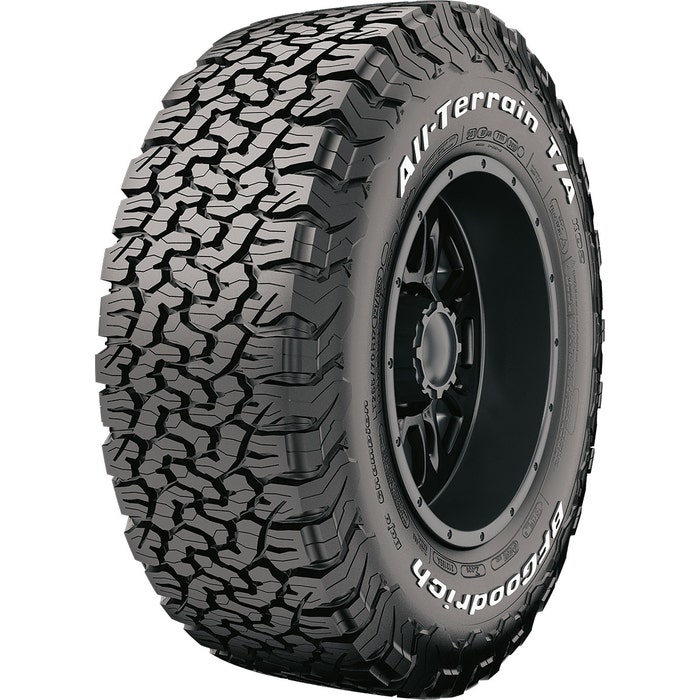
BFG All-Terrain T/A KO2 | 35X12.50R17/E
$391.00
Per Tire
35X12.5R17 121R All Terrain TA KO2 RWL Tire
As the creator of the world's first all-terrain, BFGoodrich knows a thing or two about designing year-round all-terrain tires. From pavement, to sand, to mud, to severe snow, our year-round all-terrain tires perform in any condition, any time of the year.
Genuine Raised White Letter Tire
This is a raised white letter tire, sometimes called RWL for short. Raised white letter tires became common in the late sixties on muscle cars like the Pontiac GTO and high performance pony cars, like the Ford Mustang. Raised white letter tires feature white rubber that is built into the tire's sidewall when the carcass is being assembled. The letters are formed when the tire is vulcanized in a curing mold, and then buffed clean to reveal bright white letters. Look for this classic style from our featured brands like Pro-Trac, Firestone Wide Oval and BFGoodrich Radial T/A tires.
All Terrain T/A KO2 Tires
Serrated Shoulder Design provides increased mud, snow and rock traction, especially in aired-down driving situations. Interlocking Tread Elements maximize traction and handling on- and off-road by stabilizing the tread center and providing biting edges for improved traction. Three-peak mountain snowflake symbol: Exceeds U.S. Tire Manufacturers Association (USTMA) Severe Snow Traction performance requirements.
BFGoodrich Tires | 100 Years of Outstanding Tire Fitments
Coker Tire is proud to offer a 100-year range of fitment, thanks to a huge variety of BFGoodrich tires. From the early 1900's to the modern era, the BFG product lines offer original fitments and custom sizes for hot rods, classic trucks and more. We offer BFGoodrich tires in authentic bias ply construction, as well as modern radials. Also included in the BFG line are the famous Silvertowns, Radial T/A, Phenom and All Terrain T/A KO2 tires. You won't find a more comprehensive tire product line in the world!
Please Note
- BF Goodrich All Terrain T/A KO2 tires are drop shipped. Please allow additional shipping time. These items will be drop shipped when the order is processed. Tire mounted on wheel for demonstration purposes only. Wheel and other accessories are not included. Please note that dimensions listed (tread width, section width and overall diameter) are non-scientific and based on an inflated tire, mounted to a wheel. Dimensions may vary due to rim width and inflation pressure.
| SKU | 700858 |
|---|---|
| Weight | 66.000000 |
| Brand | BFGoodrich |
| Tread Depth (32nds) | 15.0 |
| Product Size | 35X12.5R17 121R |
| Rim Diameter | 17 inch |
| Tire Construction | Radial |
| Tire Series | All Terrain TA KO2 |
| Speed Rating | R |
| Width Radial | 12.50 inches |
| Sidewall Style | RWL |
| Load Index | 121 |
| Service Description | 121R |
| Section Width (IN) | 13.0" on 10.0" |
| Revolutions per mile | 602 |
| Rim Width (in) | 8.5 - 11.0 |
| Overall Diameter (IN) | 34.50 |
| Max Load Capacity (LBS) | 3,195 lbs @ 65 psi |
| Availability Date | 2022-08-01T00:00:00Z |
This BFG All-Terrain T/A KO2 | 35X12.50R17/E comes in the 35X12.50R17 size, suitable for the classic and collector vehicles listed below.
About the 35X12.50R17 Tire Size
The 35X12.50R17 size is the tire size associated with this BFG All-Terrain T/A KO2, giving shoppers a clear reference point when matching the product to vehicle applications organized in the Coker Tire Fitment Guide. As a radial tire in the 35X12.50R17 size, it connects this product to the broader size-based fitment structure used for vehicle lookup and comparison. For more detailed information on this tire size, explore the 35X12.50R17 tire on Coker Tire Fitment Guide.
Frequently Asked Questions
Fitment & Compatibility ▼
Will the BFG All-Terrain T/A KO2 35X12.50R17/E fit my 17-inch wheel setup? ▼
The BFG All-Terrain T/A KO2 35X12.50R17/E is built for 17-inch wheels and lists an approved rim width range of 8.5 to 11.0 inches. That range matters because sidewall shape, tread contact, and steering response all change when wheel width moves toward either end of the specification. A 10-inch wheel is the measuring width used for the published 13.0-inch section width.
Before ordering, confirm wheel offset, backspacing, brake clearance, and available space at full steering lock. A tire can match wheel diameter yet still contact control arms, sway bars, inner liners, or fenders. Lift kits, leveling kits, and aftermarket suspension parts can also change real clearance results.
Will the BFG All-Terrain T/A KO2 35X12.50R17/E clear stock fenders and suspension on my truck or SUV? ▼
The published overall diameter is 34.50 inches, which is substantially larger than many factory tire packages. Diameter increases affect vertical clearance during suspension compression, while the wide casing can create rubbing near liners, mud flaps, frame rails, and steering components. Clearance must be checked with suspension loaded, not only while parked.
Real-world fitment depends on wheel offset and ride height as much as tire size. A wheel that pushes the tire outward may clear inner components but increase fender contact during turns. A wheel tucked inward may do the opposite. Measure full lock and bump travel before purchase to avoid trimming or alignment surprises.
How will the BFG All-Terrain T/A KO2 35X12.50R17/E change speedometer accuracy? ▼
With a 34.50-inch diameter, the BFG All-Terrain T/A KO2 35X12.50R17/E can travel farther per revolution than smaller original tires. The listing shows 602 revolutions per mile, which helps estimate calibration differences. On many vehicles, a larger tire causes the speedometer to read slower than actual road speed.
That change also affects odometer mileage and automatic transmission shift behavior on electronically controlled vehicles. Some owners reprogram tire size through factory software, aftermarket tuners, or calibration modules. Comparing current tire revolutions per mile against the new figure is the cleanest way to predict the real change before installation.
Tire Size Equivalents & Conversions ▼
How does the BFG All-Terrain T/A KO2 35X12.50R17/E compare with smaller factory tire sizes? ▼
Compared with many stock truck sizes, the BFG All-Terrain T/A KO2 35X12.50R17/E is usually taller and wider. A larger diameter raises effective gearing, can reduce engine rpm at cruise, and may soften acceleration. A wider footprint can improve traction but may also increase steering load and road noise depending on vehicle setup.
Because factory sizes vary widely, the best comparison is against your current tire’s actual diameter and width. Even a one-inch change can affect speedometer readings and clearance. Knowing the starting size prevents guessing and gives a much clearer picture of what the upgrade will feel like.
Performance & Use Case ▼
How will the BFG All-Terrain T/A KO2 35X12.50R17/E drive on the highway? ▼
The radial construction of the BFG All-Terrain T/A KO2 35X12.50R17/E generally supports more stable highway behavior than old-style bias construction. Interlocking tread elements are intended to help tread stability, which can improve straight-line confidence and steering consistency during normal road driving.
Any 35-inch all-terrain tire still brings trade-offs. Added mass and aggressive tread design can influence acceleration, braking feel, and cabin noise depending on vehicle insulation and gearing. Proper balancing, alignment, and pressure are critical because larger tires can amplify minor setup issues at speed.
Is the BFG All-Terrain T/A KO2 35X12.50R17/E good in rain and mixed weather? ▼
The product is marketed for year-round use across pavement, mud, sand, and severe snow conditions. For mixed weather buyers, that signals broader capability than a dry-road performance tire. The tread pattern includes multiple biting edges intended to support traction when surfaces are loose or slippery.
Wet-road performance still depends on tread depth, inflation, alignment, and driving style. Standing water requires caution with any wide tire because more water must be evacuated from the contact patch. As tread wears over time, wet performance can change, so regular inspection remains important.
How does the BFG All-Terrain T/A KO2 35X12.50R17/E perform off-road when aired down? ▼
The page highlights serrated shoulders for traction in mud, snow, and rock, especially during aired-down use. Lower pressures can enlarge the contact patch, helping the tire conform to terrain and improve grip on loose or uneven surfaces. That is one reason many trail users value all-terrain designs.
Pressure changes should be controlled carefully. Excessively low pressure without proper wheel retention can risk bead issues, while driving too fast at low pressure increases heat and casing stress. Reinflate to appropriate road pressure before highway travel to restore handling stability and reduce wear.
Construction, Durability & Load Capacity ▼
What does load index 121 mean on the BFG All-Terrain T/A KO2 35X12.50R17/E? ▼
Load index 121 corresponds with the listed maximum load capacity of 3,195 pounds when used at the stated maximum pressure. That number helps buyers compare carrying capability across tire options instead of relying only on size names or appearance.
Load capacity should be matched to real vehicle use, including passengers, cargo, trailer tongue weight, and accessories like bumpers or winches. A heavier build can need more capacity than a stock vehicle. Always stay within vehicle and wheel limits as well as tire ratings.
How does tread depth help the BFG All-Terrain T/A KO2 35X12.50R17/E last? ▼
The listing shows 15/32-inch tread depth, which is substantial for all-terrain use. Deeper tread can provide more usable life before replacement and helps maintain traction features over time, especially on mixed surfaces where biting edges are valuable.
Longevity still depends on rotation intervals, alignment, pressure, and driving style. Aggressive acceleration, chronic underinflation, or poor alignment can wear even deep tread quickly. Buyers seeking maximum life should view tread depth as one advantage within a larger maintenance picture.
How durable is the BFG All-Terrain T/A KO2 35X12.50R17/E for mixed-use ownership? ▼
The product is positioned for pavement, mud, sand, snow, and rock, indicating a broad-use design rather than a single-environment tire. That versatility is valuable for owners who alternate between commuting, weather exposure, and outdoor travel throughout the year.
Durability still depends on maintenance habits and impact exposure. Repeated curb strikes, overloaded use, neglected rotations, or prolonged underinflation shorten service life. Buyers often get the best results when setup, inspection, and rotation discipline match the tire’s intended multi-use capability.
Installation & Maintenance ▼
What wheel width is best for the BFG All-Terrain T/A KO2 35X12.50R17/E? ▼
The approved wheel-width range is 8.5 to 11.0 inches, giving flexibility for different builds. A mid-range wheel often provides balanced sidewall shape, predictable road manners, and even tread support. That is why many buyers start near the center of the approved range.
Moving narrower or wider can be useful depending on goals. Narrower setups may favor sidewall protection and aired-down behavior, while wider setups can sharpen appearance and steering feel. Clearance and wheel offset should always be checked alongside width choice.
How often should the BFG All-Terrain T/A KO2 35X12.50R17/E be rotated? ▼
Regular rotation helps equalize wear across all four tires, especially on trucks and SUVs where front and rear axle loads differ. Steering tires often wear differently from driven tires, so rotation is one of the simplest ways to extend service life and maintain consistent behavior.
Use the vehicle manufacturer’s maintenance schedule or a trusted service interval. Also inspect tread wear patterns during each rotation. Uneven wear can reveal pressure or alignment issues early, allowing correction before significant tread life is lost.
How do I maintain ride quality with the BFG All-Terrain T/A KO2 35X12.50R17/E? ▼
Ride quality is shaped by more than tread pattern. Pressure tuning, suspension condition, wheel weight, and seat-of-pants expectations all play a role. Many harsh-ride complaints come from overinflation or worn shocks rather than the tire itself.
Start with sensible pressure for actual load, then verify shocks, bushings, and steering components are healthy. If the vehicle is heavily modified, spring rates may dominate ride feel more than tire choice. Small setup changes often create the biggest comfort gains.
Write Your Own Review
Popular Add-Ons For Your Order