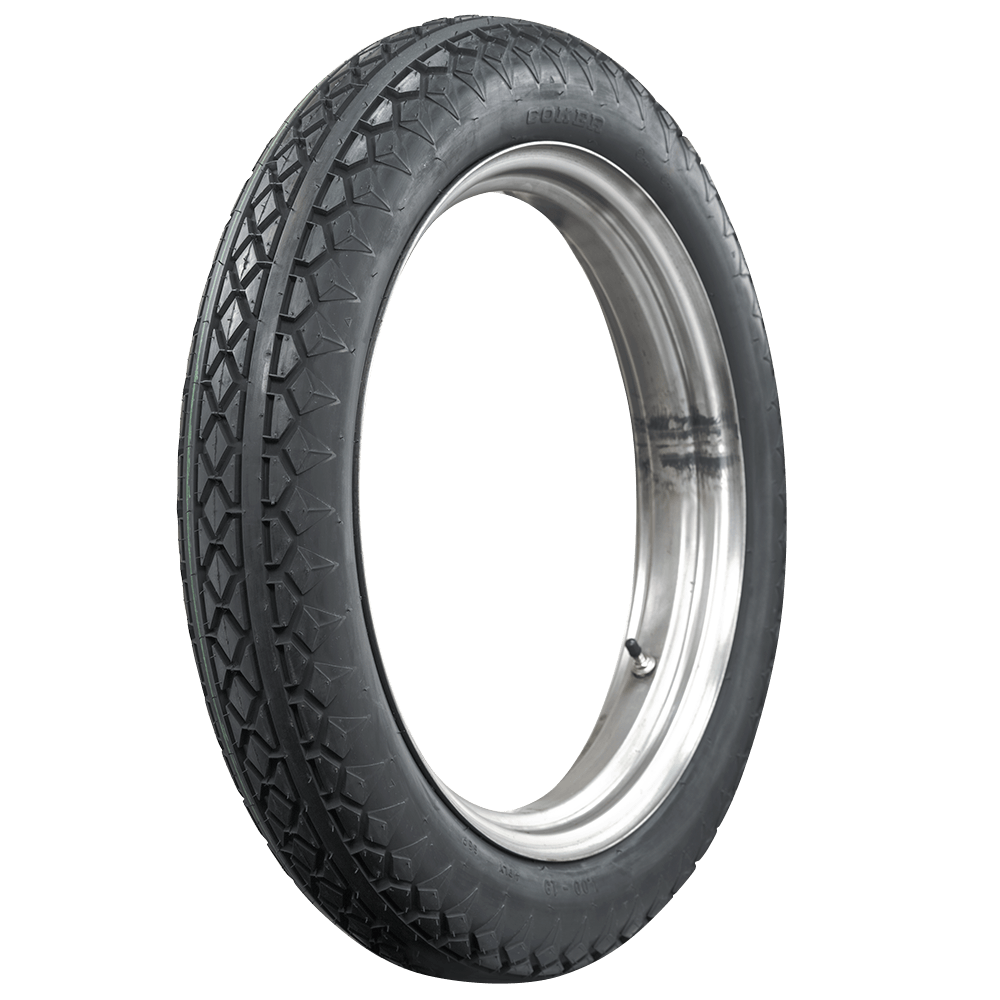
300-21 Firestone Classic Blackwall Motorcycle Tire
Custom bike builders have been chanting for a good 21 inch motorcycle tire for their projects for years. The Firestone 2.75-21 and 3.00-21 tires are an excellent fit for choppers, custom motorcycles and race-inspired bikes using a narrow twenty-one inch front wheel. These Firestone Ribbed Motorcycle tires have a straight-groove tread pattern and a simple sidewall design. These are a great vintage look for any custom motorcycle with a 21-inch front wheel. Coker Tire Company caters to custom motorcycle builders around the world with several Firestone product offerings for vintage and custom bikes.
Blackwall Tire
Since the introduction of carbon black rocked the tire industry, the original recipe for most tires has been a solid black sidewall. For classics and collector cars alike, it's hard to beat the no-nonsense appeal of a classic blackwall style tire. British sports car, classic truck and even hot rod enthusiasts love the way a nice period correct blackwall tire looks on their vehicles.
Bias Ply Construction
Bias ply tire construction is a method that was used from the 1900's through the 1970's on passenger cars and light trucks. Bias ply tires feature ply cords that run at a 45 degree angle to the bead, and overlap in a crisscross pattern, depending on how many ply layers are used. This creates a strong tire, but bias ply tires have a tendency to follow breaks or ruts in the pavement. Bias ply tires are the most authentic choice for classic car restorations and traditional hot rod builds. Coker Tire offers a huge variety of bias ply tires for many applications.
Firestone Dragster Cheater Tires
Firestone Dragster tires are bias ply cheater slicks that have just enough tread to be DOT approved. These retro styled cheater slicks are available in black sidewall and wide whitewall, and available in four sizes to fit 15 or 16 inch wheels.
Firestone Tires for Collector Vehicles
The vintage line of Firestone tires fits a wide range of cars, trucks and motorcycles built from the 1900's through the 1970's. Firestone Non Skid tires, Firestone Deluxe Champion tires, Firestone Wide Oval tires and many more famous styles and sizes are available to fit military vehicles, motorcycles and classic commercial trucks. With whitewalls, redlines, raised white letters and other classic sidewall styles, this product line is one of the most extensive and popular brands for classic cars.
Please Note
- Tire mounted on wheel for demonstration purposes only. Wheel and other accessories are not included. Please note that dimensions listed (tread width, section width and overall diameter) are non-scientific and based on an inflated tire, mounted to a wheel. Dimensions may vary due to rim width and inflation pressure.
| SKU | 74774 |
|---|---|
| Weight | 15.000000 |
| Brand | Firestone |
| Product Size | 300-21 |
| Tube Type or Tubeless | Tube Type |
| Rim Diameter | 21 inch |
| Tire Construction | Bias Ply |
| Tire Series | Firestone Classic Motorcyle |
| Sidewall Style | Blackwall |
| Motorcycle Sizes | 300-21 |
| Section Width (IN) | 2.91 |
| Rim Width (in) | 1.85 |
| Overall Diameter (IN) | 27.17 |
| Availability Date | 2027-02-26T00:00:00Z |
300-21 Firestone Classic Blackwall Bias Ply Motorcycle Tire
Frequently Asked Questions
Fitment & Compatibility ▼
Will the Firestone Classic Motorcycle Ribbed 300-21 fit my 21-inch front wheel motorcycle? ▼
The Firestone Classic Motorcycle Ribbed 300-21 is specifically designed for 21-inch front wheels and is commonly used on choppers, custom builds, and vintage-style motorcycles. With a narrow 2.91-inch section width, it delivers the slim front tire profile typical of classic and custom bikes.
Fitment depends on using a compatible 1.85-inch rim width. Clearance is typically not an issue due to the narrow profile, but fork spacing and brake components should still be checked to ensure proper installation and alignment.
Will the Firestone Classic Motorcycle Ribbed 300-21 work with custom chopper builds? ▼
This tire is widely used in chopper and custom motorcycle builds due to its narrow profile and vintage ribbed tread design. It provides the classic skinny front tire look associated with long-fork builds.
Its design complements extended rake geometry and narrow front ends. However, builders should confirm proper alignment and fork geometry to maintain stable steering and avoid tracking issues at higher speeds.
Will the Firestone Classic Motorcycle Ribbed 300-21 work with modern brake upgrades? ▼
The narrow profile generally provides adequate clearance for many brake setups. However, modern disc brake conversions may require additional spacing considerations.
Builders should verify rotor and caliper clearance, especially on custom forks. Ensuring proper alignment and avoiding interference is essential for safe braking performance and consistent operation.
Tire Size Equivalents & Conversions ▼
How does the Firestone Classic Motorcycle Ribbed 300-21 compare to a 275-21 tire? ▼
The 300-21 is slightly wider than a 275-21, providing a marginally larger contact patch. This can improve front-end stability and road feel.
However, the difference is subtle, and both sizes maintain a narrow front profile. The 300-21 offers a slightly fuller look while still preserving the classic skinny tire appearance.
Will the Firestone Classic Motorcycle Ribbed 300-21 affect speedometer accuracy? ▼
Front tire size has minimal impact on speedometer accuracy for most motorcycles, as speed is typically measured from the transmission or rear wheel.
However, changes in overall diameter can slightly influence handling geometry. Maintaining a similar size to original specifications helps preserve intended ride characteristics.
Can the Firestone Classic Motorcycle Ribbed 300-21 replace a metric front tire? ▼
This tire can replace certain metric sizes if overall diameter and width are comparable. It is commonly used in custom builds where exact metric matching is less critical.
Careful measurement is required to ensure proper fitment. Differences in width and profile can affect handling and clearance, so verification is important before installation.
Performance & Use Case ▼
How does the Firestone Classic Motorcycle Ribbed 300-21 perform on the road? ▼
The Firestone Classic Motorcycle Ribbed 300-21 is designed for stable front-end tracking rather than aggressive grip. The ribbed tread pattern helps the tire follow a straight line, improving directional stability during cruising.
This makes it well suited for choppers and vintage-style motorcycles used for relaxed riding. However, it is not designed for aggressive cornering or high-performance riding, so smooth inputs and moderate speeds are recommended for best results.
Is the Firestone Classic Motorcycle Ribbed 300-21 suitable for wet conditions? ▼
The tread pattern provides basic water displacement, but it is not optimized for modern wet performance. Riders should use caution in rain.
Reduced contact patch and limited siping mean less grip on wet surfaces. Slower speeds and increased braking distance are recommended for safe riding.
How does the Firestone Classic Motorcycle Ribbed 300-21 track at higher speeds? ▼
The ribbed tread pattern enhances straight-line tracking, making the tire stable at cruising speeds. It resists wandering better than some older designs.
However, higher speeds can highlight the limitations of bias ply construction. Proper inflation and alignment are essential to maintain stability and reduce vibration.
Construction, Durability & Load Capacity ▼
What does the 6 ply construction mean for the Firestone Classic Motorcycle Ribbed 300-21? ▼
The 6 ply nylon construction provides strength and durability suitable for vintage and custom motorcycle applications. It supports consistent performance under normal riding conditions.
This construction also helps resist punctures and wear. However, it still requires proper maintenance and inspection to ensure long-term reliability.
Is the Firestone Classic Motorcycle Ribbed 300-21 resistant to heat buildup? ▼
Bias ply tires manage heat differently than radials and are best suited for moderate speeds. Proper inflation helps control heat generation.
Excessive speed or underinflation can increase heat buildup. Maintaining recommended pressure is essential for preserving tire integrity.
How does tread life compare to modern motorcycle tires? ▼
Tread life is generally shorter than modern radial motorcycle tires due to bias ply construction. Wear patterns may vary depending on use.
Proper maintenance and moderate riding can extend lifespan. This tire prioritizes authenticity and style over maximum longevity.
Installation & Maintenance ▼
What tire pressure should I use for the Firestone Classic Motorcycle Ribbed 300-21? ▼
Proper tire pressure depends on the motorcycle and riding conditions. Maintaining correct pressure ensures stability and even wear.
Underinflation increases heat and wear, while overinflation reduces contact patch. Regular pressure checks are essential for safe operation.
Does the Firestone Classic Motorcycle Ribbed 300-21 require balancing? ▼
Yes, balancing is important for smooth operation, especially at higher speeds. It helps prevent vibration and uneven wear.
Proper balancing improves ride comfort and extends tire life. It should be performed during installation and checked periodically.
How often should the Firestone Classic Motorcycle Ribbed 300-21 be inspected? ▼
Regular inspection is important due to the tire’s narrow profile and bias ply construction. Checking for wear and damage ensures safe operation.
Frequent checks help identify issues early. Monitoring tread condition and sidewall integrity supports long-term performance.
Can I install the Firestone Classic Motorcycle Ribbed 300-21 myself? ▼
Professional installation is recommended to ensure proper mounting and tube installation. This reduces the risk of damage or improper fitment.
Incorrect installation can lead to vibration or failure. Using correct tools and techniques ensures reliable performance.
Write Your Own Review
OTHER STUFF YOU MAY LIKE
Check items to add to the cart or



Customers Also Bought