

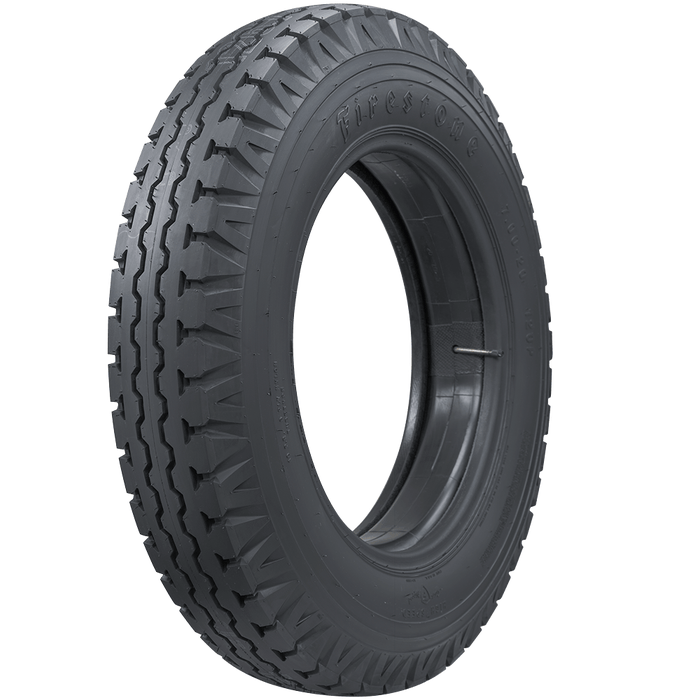

700-20 Firestone Classic Truck Blackwall Tire
Firestone bias ply antique truck tires feature authentic sidewall design. These tires are excellent fitment for restored or surviving vintage trucks with several sizes for 20-inch wheels. Firestone vintage truck tires are hand built in the USA from premium materials.
Blackwall Tire
Since the introduction of carbon black rocked the tire industry, the original recipe for most tires has been a solid black sidewall. For classics and collector cars alike, it's hard to beat the no-nonsense appeal of a classic blackwall style tire. British sports car, classic truck and even hot rod enthusiasts love the way a nice period correct blackwall tire looks on their vehicles.
Bias Ply Construction
Bias ply tire construction is a method that was used from the 1900's through the 1970's on passenger cars and light trucks. Bias ply tires feature ply cords that run at a 45 degree angle to the bead, and overlap in a crisscross pattern, depending on how many ply layers are used. This creates a strong tire, but bias ply tires have a tendency to follow breaks or ruts in the pavement. Bias ply tires are the most authentic choice for classic car restorations and traditional hot rod builds. Coker Tire offers a huge variety of bias ply tires for many applications.
Firestone Classic Truck Tires
Firestone Classic Truck tires feature heavy duty construction and sizes to fit thousands of truck applications, including light, medium and heavy duty trucks from the 1920’s through the 1950’s. Firestone classic truck tires are authentic to the originals.
Firestone Tires for Collector Vehicles
The vintage line of Firestone tires fits a wide range of cars, trucks and motorcycles built from the 1900's through the 1970's. Firestone Non Skid tires, Firestone Deluxe Champion tires, Firestone Wide Oval tires and many more famous styles and sizes are available to fit military vehicles, motorcycles and classic commercial trucks. With whitewalls, redlines, raised white letters and other classic sidewall styles, this product line is one of the most extensive and popular brands for classic cars.
Please Note
- Tire mounted on wheel for demonstration purposes only. Wheel and other accessories are not included. Please note that dimensions listed (tread width, section width and overall diameter) are non-scientific and based on an inflated tire, mounted to a wheel. Dimensions may vary due to rim width and inflation pressure.
| SKU | 761401 |
|---|---|
| Weight | 46.000000 |
| Construction Ply | 8 PLY POLY |
| Brand | Firestone |
| Tread Depth (32nds) | 12 |
| Product Size | 700-20 |
| Tube Type or Tubeless | Tube Type |
| Rim Diameter | 20 inch |
| Tire Construction | Bias Ply |
| Tire Series | Firestone Classic Truck |
| Sidewall Style | Blackwall |
| Width Bias Ply | 7.00 |
| GTIN | 00842199104080 |
| Max Load Capacity (LBS) | 3150@90 psi |
| Section Width (IN) | 6.90 |
| Rim Width (in) | 5 |
| Overall Diameter (IN) | 35.00 |
| Availability Date | 2026-08-31T00:00:00Z |
This Firestone | Truck Tread comes in the 700-20 size, suitable for the classic and collector vehicles listed below.
About the 700-20 Tire Size
The 700-20 tire size is associated with select late-1920s through early-1930s vehicle applications, spanning 1926 to 1933 across makes such as Studebaker, Marmon, Cadillac, Cunningham, Packard, Stearns-Knight, and Stutz. For shoppers viewing Firestone | Truck Tread | 700-20, this size connects the product's bias-ply Truck Tread application with a period-correct range of classic and collector vehicles. For more detailed information on this tire size, explore the 700-20 tire on Coker Tire Fitment Guide.
Vehicle Fitment for the Firestone | Truck Tread | 700-20
The Firestone | Truck Tread | 700-20 is available in a tire size associated with a range of classic and collector vehicles. The vehicle applications below are organized by year, make, and model to help identify vehicles associated with the 700-20 size. Explore the linked Make & Model and Year Make & Model pages for more detailed fitment information.
Fitment information should be verified for the specific vehicle before purchase. Confirm tire size, wheel fit, load requirements, overall diameter, and available clearance.
1926–19308 makes · 18 fitments
The 1926–1930 period includes a broad range of 700-20 applications spanning Studebaker, Marmon, Stearns-Knight, Cadillac, Stutz, Cunningham, Packard, and Stearns-Knight. These applications reflect the breadth of vehicles associated with the 700-20 size during the late 1920s and 1930 model year.
Studebaker
Studebaker applications in this period include the Big 6 Cyl.
Marmon
Marmon applications in this period include the 75 Series.
Stearns-Knight
Stearns-Knight applications in this period include the Gt. 8, 8H, 8J, F6-85, H8-90, and J8-90.
Cadillac
Cadillac applications in this period include the 8 Cyl.
Stutz
Stutz applications in this period include the BB.
Cunningham
Cunningham applications in this period include the 8 and 9.
Packard
Packard applications in this period include the 633 Series and 645 Series.
1931–19352 makes · 2 fitments
The 1931–1935 period includes select 700-20 applications from Stutz and Cunningham. These listings show a narrower set of vehicles associated with the 700-20 size in the early 1930s.
Stutz
Stutz applications in this period include the MB.
Cunningham
Cunningham applications in this period include the 8.
Frequently Asked Questions
Fitment & Compatibility ▼
Will the Firestone Truck Tread 700-20 fit my original 20-inch vintage truck wheels? ▼
The Firestone Truck Tread 700-20 is built for 20-inch wheels and lists a recommended 5-inch rim width, so original wheels matching that size are the best starting point. Many restored commercial trucks from the 1920s through 1950s used narrow multi-piece or heavy-duty 20-inch wheels, making wheel measurement important before ordering. Confirm bead seat diameter and actual rim width rather than relying only on old markings.
The 35-inch overall diameter and 6.90-inch section width also affect fitment beyond wheel diameter alone. Check fender clearance, steering arm clearance, and rear dual spacing if applicable. A truck with worn springs or altered suspension height may have less clearance under compression than factory specifications suggest.
Will the Firestone Truck Tread 700-20 feel heavier to steer at low speeds? ▼
The Firestone Truck Tread 700-20 is a tall bias ply truck tire, so steering effort can feel heavier than smaller or modern radial alternatives, especially on manual steering trucks during parking maneuvers. Tall tires create leverage at the contact patch, and vintage steering systems often have slower ratios and more friction than modern designs.
Inflation pressure, front axle weight, alignment, and wheel width all influence steering feel. Underinflation increases scrub and can make low-speed turning noticeably harder. Proper kingpin condition and correct toe settings help as much as tire choice. Once moving, steering effort usually drops, though response remains more vintage than modern.
Tire Size Equivalents & Conversions ▼
What modern size is closest to the Firestone Truck Tread 700-20? ▼
The Firestone Truck Tread 700-20 uses an older numeric sizing system, so there is no perfect one-number modern equivalent. Matching overall diameter, load ability, and mounted width matters more than copying a label. With a 35-inch diameter and narrow 6.90-inch section width, the tire is tall and relatively slim compared with many modern truck sizes.
Many modern replacements become wider than expected, which can create steering and clearance issues on vintage trucks. A wider radial may fit the wheel opening yet rub springs or fenders. The safest approach is comparing measured dimensions, wheel width requirements, and intended use rather than relying on a conversion chart alone.
How does the Firestone Truck Tread 700-20 compare in diameter to common modern truck tires? ▼
At 35 inches tall, the Firestone Truck Tread 700-20 is larger in diameter than many common modern light truck tires. Diameter influences gearing, cruise rpm, and visual stance more than tread style alone. Trucks currently running smaller replacements may sit lower and turn higher rpm than they would with the original-style size.
Moving back to a 35-inch diameter can improve period-correct proportions, but always recheck clearance at the front axle and rear wheel openings. Larger diameter tires swing through a bigger arc while turning. Speedometer readings can also change, especially if the truck has used undersized tires for years.
Can the Firestone Truck Tread 700-20 replace mixed sizes already installed on my truck? ▼
The Firestone Truck Tread 700-20 can replace mixed sizes, but first determine why mixed sizes were installed. Some old trucks received mismatched tires because correct sizes were unavailable, while others were altered to change gearing or stance. Restoring one consistent size usually improves balance, braking behavior, and appearance.
Measure current diameters front and rear, inspect wheel widths, and verify load needs before converting all positions. On dual rear trucks, matching all tires becomes even more important. Mixed diameters can create uneven load sharing and drivetrain strain. A consistent set usually simplifies maintenance and rotation planning.
Performance & Use Case ▼
How will the Firestone Truck Tread 700-20 drive on normal roads? ▼
The Firestone Truck Tread 700-20 delivers a traditional vintage driving feel consistent with period truck tires. Expect slower steering response and more feedback through the wheel than modern radials. Many owners appreciate that authentic character because it matches the mechanical personality of older trucks.
Road surface changes are more noticeable with bias ply construction. Grooves, patched pavement, and crowned roads can influence tracking more than with modern tires. Proper alignment and inflation help significantly. For local drives, events, and moderate-speed cruising, the experience feels authentic rather than overly modernized.
Is the Firestone Truck Tread 700-20 a good choice for a fully restored show truck? ▼
The Firestone Truck Tread 700-20 is a strong fit for fully restored trucks because it combines authentic Firestone branding, period styling, and bias ply construction. Visual correctness matters on judged restorations, and modern-looking tires can quickly break the era-correct appearance of an otherwise accurate build.
The blackwall sidewall also suits working-truck aesthetics better than decorative sidewall treatments. For trucks that are trailered or driven lightly, compromises in modern handling are usually minor concerns. Buyers focused on presentation and originality often place this type of tire high on the list.
Is the Firestone Truck Tread 700-20 suitable for hauling moderate loads? ▼
The Firestone Truck Tread 700-20 lists a maximum load capacity of 3150 pounds at 90 psi, showing it is built for serious vintage truck duty when used correctly. That rating provides useful capacity for many restored commercial trucks carrying moderate cargo or equipment.
Actual safe loading depends on axle ratings, wheel condition, suspension health, and using the correct number of tires. Never judge capacity by tire rating alone. Inflation pressure must match the intended load, because underinflation increases heat and casing stress. Sensible loading practices remain essential on older vehicles.
Construction, Durability & Load Capacity ▼
How durable is the Firestone Truck Tread 700-20 for occasional hobby use? ▼
For occasional hobby use, the Firestone Truck Tread 700-20 should provide solid service when stored and maintained properly. Seasonal cruises, events, and fair-weather driving are generally easier on tires than daily commercial use. Proper inflation and avoiding overload are major contributors to longevity.
Storage conditions matter just as much as mileage. Keep the truck away from prolonged sunlight, ozone sources, and moisture when parked. Regular inspections for cracking, uneven wear, or impact damage help catch issues early. Vintage tires reward attentive ownership more than neglect.
What does the 8 ply poly rating mean on the Firestone Truck Tread 700-20? ▼
The 8 ply poly specification indicates a heavy-duty construction level intended for truck service. It reflects strength and load-support capability rather than meaning eight visible layers in a simple literal sense. For buyers, it signals a tire built with commercial-duty expectations.
That construction can support heavier applications when used within rated limits, but ride feel may be firmer than lighter passenger-car tires. Inflation choice becomes important because very high pressure without corresponding load can affect comfort and footprint shape. Use vehicle needs, not maximum pressure alone, as the guide.
Installation & Maintenance ▼
Does the Firestone Truck Tread 700-20 require tubes? ▼
The Firestone Truck Tread 700-20 is listed as a tube type tire, so an appropriate inner tube is required for correct installation. Tube type construction is common on vintage truck applications using older wheel designs. Using the proper tube and valve stem style is part of a safe setup.
The product page also shows compatible tube options, which is a useful reminder not to reuse unknown old tubes. A fresh tube reduces the chance of age-related failures. Inspect the wheel carefully for rust, burrs, or damage before assembly.
Who should mount the Firestone Truck Tread 700-20? ▼
The Firestone Truck Tread 700-20 is best mounted by a shop experienced with vintage truck wheels and tube-type assemblies. Older commercial wheels can differ greatly from modern one-piece rims, and some require specialized procedures and safety equipment.
This is especially important if the truck uses multi-piece or lock-ring wheels. Incorrect handling can be dangerous. A qualified installer can also inspect wheel condition, confirm tube compatibility, and set inflation properly. Professional mounting is usually the safest path for heavy vintage truck tires.
How often should the Firestone Truck Tread 700-20 be inspected? ▼
The Firestone Truck Tread 700-20 should be visually inspected before drives and more thoroughly at regular service intervals. Look for cuts, cracking, embedded debris, uneven wear, and pressure loss. Collector vehicles often sit long enough for slow issues to go unnoticed.
A deeper inspection after longer trips is wise, especially on loaded trucks or in hot weather. Check valve stems, tube retention, and wheel hardware condition where applicable. Frequent inspections are one of the simplest ways to avoid roadside problems on older vehicles.
Write Your Own Review
OTHER STUFF YOU MAY LIKE
Check items to add to the cart or


More Tires This Size


