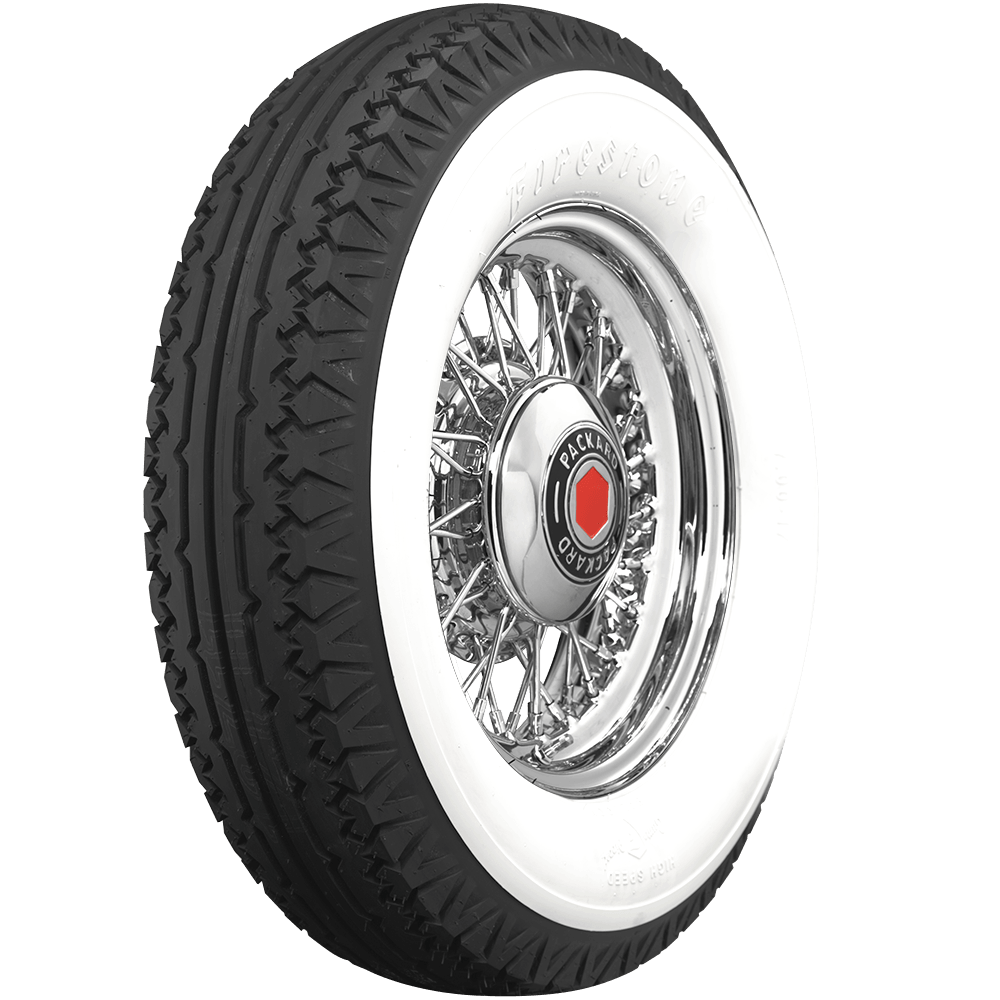
650-19 Lester Classic Blackwall Tire
650-19 Lester Blackwall TireLester tires have been a dominant leader in the vintage tire market for many years and feature a pre-siped tread design for better performance.Classic Styling in a Hard-to-Find Size Made in USA.
Blackwall Tire
Since the introduction of carbon black rocked the tire industry, the original recipe for most tires has been a solid black sidewall. For classics and collector cars alike, it's hard to beat the no-nonsense appeal of a classic blackwall style tire. British sports car, classic truck and even hot rod enthusiasts love the way a nice period correct blackwall tire looks on their vehicles.
Bias Ply Construction
Bias ply tire construction is a method that was used from the 1900's through the 1970's on passenger cars and light trucks. Bias ply tires feature ply cords that run at a 45 degree angle to the bead, and overlap in a crisscross pattern, depending on how many ply layers are used. This creates a strong tire, but bias ply tires have a tendency to follow breaks or ruts in the pavement. Bias ply tires are the most authentic choice for classic car restorations and traditional hot rod builds. Coker Tire offers a huge variety of bias ply tires for many applications.
Lester Classic Tires
Focused on authenticity, the Lester brand offers period correct styling and fitments for many cars from the 1900's through the 1950's. Available in wide whitewall and blackwall, Lester bias ply tires are specially designed for antique cars, and continue to be a favorite among car collectors around the world.
Please Note
- Tire mounted on wheel for demonstration purposes only. Wheel and other accessories are not included. Please note that dimensions listed (tread width, section width and overall diameter) are non-scientific and based on an inflated tire, mounted to a wheel. Dimensions may vary due to rim width and inflation pressure. Please note Chemical Guys Tire and Rubber Cleaner and Adams Polish Tire shine has been linked to Whitewall browning and should not be used. We recommend using our line of tire care products.
| SKU | 74240 |
|---|---|
| Weight | 29.000000 |
| Availability Date | 2025-11-06T00:00:00Z |
| Sidewall Style | Blackwall |
| Tire Construction | Bias Ply |
| Tire Series | Lester Classic Bias Ply |
| Rim Diameter | 19 inch |
| Tube Type or Tubeless | Tube Type |
| Product Size | 650-19 |
| Width Bias Ply | 6.50 |
| Brand | Lester |
This Lester comes in the 650-19 size, suitable for the classic and collector vehicles listed below.
About the 650-19 Tire Size
The 650-19 is a vintage tire size associated with a broad range of vehicles from 1928 through 1933, including applications across makes such as Franklin, Graham, Packard, Peerless, Pierce Arrow, and Studebaker. For shoppers viewing Lester | 650-19, this size connects the product directly to period vehicle applications where a 650-19 tire is relevant, and the Lester naming also identifies it as a bias ply tire. For more detailed information on this tire size, explore the 650-19 tire on Coker Tire Fitment Guide.
Vehicle Fitment for the Lester | 650-19
The Lester | 650-19 is available in a tire size associated with a range of classic and collector vehicles. The vehicle applications below are organized by year, make, and model to help identify vehicles associated with the 650-19 size. Explore the linked Make & Model and Year Make & Model pages for more detailed fitment information.
Fitment information should be verified for the specific vehicle before purchase. Confirm tire size, wheel fit, load requirements, overall diameter, and available clearance.
1928–193215 makes · 42 fitments
The 1928–1932 period includes a broad spread of 650-19 applications across Buick, Cadillac, Franklin, Graham, Hupmobile, La Salle, Marmon, Moon, Nash, Packard, Peerless, Pierce Arrow, Studebaker, Windsor, and more. These applications show the breadth of vehicles associated with the 650-19 size during the late 1920s and early 1930s.
Graham
Graham applications in this period include the 35, 27, 37, and Custom.
Moon
Moon fitment in this period is represented by the 80 Series.
Studebaker
Studebaker applications in this period are represented by the President.
Franklin
Franklin applications in this period include the 135 Series, 137 Series, 145 Series, 147 Series, 15 Deluxe, and 16 Airman.
La Salle
La Salle applications in this period include the 8 Cyl. and 340.
Peerless
Peerless applications in this period include the 125 Series, 8 Cyl., and Custom.
Pierce Arrow
Pierce Arrow applications in this period include the 125 Series, 126 Series, C, and 43 Series.
Windsor
Windsor applications in this period are represented by the 92 Series.
Buick
Buick applications in this period include the 50 Series, 80 Series, and 90 Series.
Hupmobile
Hupmobile applications in this period are represented by the H & U.
Marmon
Marmon applications in this period include the Big 8 and 88 Series.
Nash
Nash applications in this period include the 8 Cyl. and 90 Series.
Packard
Packard applications in this period include the 882 & 892 Series, 826 Series, 833 Series, and 901 & 902 Series.
Cadillac
Cadillac fitment in this period is represented by the V8.
19332 makes · 2 fitments
The 1933 period includes 650-19 applications for Franklin and Stutz. These entries reflect select later applications for the 650-19 size.
Franklin
Franklin fitment in this period is represented by the Airman.
Stutz
Stutz fitment in this period is represented by the LAA.
Frequently Asked Questions
Fitment & Compatibility ▼
Will the Lester 650-19 Blackwall Tire work with original 19-inch wheels? ▼
The Lester 650-19 Blackwall Tire is intended for vehicles equipped with 19-inch wheels that originally accepted a 650-19 tire size. Maintaining the correct wheel diameter is essential because vintage tire sizing systems differ from modern metric tire designations and are closely tied to original vehicle engineering.
Owners restoring antique vehicles should verify wheel integrity, bead seating surfaces, and overall wheel condition before installation. Original wheels can develop corrosion, distortion, or wear over decades of use. Proper wheel condition helps ensure correct tire mounting, air retention, and safe operation while preserving the authentic appearance expected from a period-correct restoration.
Will the Lester 650-19 Blackwall Tire maintain original vehicle stance? ▼
One of the primary reasons enthusiasts choose the Lester 650-19 Blackwall Tire is to preserve the vehicle's original visual proportions. Tire diameter plays a major role in determining ride height, wheelwell appearance, and the overall stance that manufacturers originally intended for antique automobiles.
Changing to a significantly different tire size can alter fender gaps, affect speedometer accuracy, and modify suspension geometry. By remaining with the factory-style 650-19 sizing, owners are more likely to maintain authentic vehicle posture and visual balance. This is especially important for judged restorations, museum-quality vehicles, and historically accurate preservation projects.
Is the Lester 650-19 Blackwall Tire suitable for restoration projects? ▼
The Lester 650-19 Blackwall Tire is specifically positioned as a restoration-focused tire with period-correct styling and bias ply construction. It is intended for collectors seeking authenticity and visual accuracy on vehicles from the early automotive era through the mid-twentieth century.
Authenticity extends beyond appearance alone. The tire's construction method, tread design, and overall character closely reflect what many antique vehicles originally used. For owners participating in concours events, historical displays, museum exhibits, or preservation-focused restorations, maintaining a historically appropriate tire can be an important component of overall vehicle correctness.
Tire Size Equivalents & Conversions ▼
Can the Lester 650-19 Blackwall Tire replace another 650-19 tire? ▼
The Lester 650-19 Blackwall Tire is intended as a direct replacement for vehicles already equipped with a 650-19 tire size. This makes it a straightforward option for restorations where maintaining original specifications is a priority.
Although replacement is typically simple when sizes match, owners should recognize that dimensions can vary slightly among manufacturers. Tire shape, inflation pressure, and wheel dimensions can influence overall installed measurements. Checking vehicle clearances and comparing specifications before installation helps ensure the replacement performs as expected.
Can the Lester 650-19 Blackwall Tire replace modern radial conversions? ▼
The Lester 650-19 Blackwall Tire can physically replace modern conversions only if wheel diameter and overall fitment requirements align. However, buyers should understand that switching from radial construction back to bias ply construction changes driving characteristics significantly.
Bias ply tires typically exhibit more sidewall movement and can follow road grooves more noticeably than radials. Steering feel, tracking behavior, and ride quality may differ from what drivers have become accustomed to with modern tires. Restoration-focused owners often accept these differences because authenticity is their primary objective.
Why choose the Lester 650-19 Blackwall Tire over alternative sizing? ▼
The strongest reason to choose the Lester 650-19 Blackwall Tire is preservation of original vehicle specifications. Factory sizing influences numerous aspects of vehicle behavior, including ride height, steering characteristics, visual stance, and instrument accuracy.
Alternative sizes can sometimes fit physically, but they often introduce secondary effects that become noticeable over time. Clearance issues, altered steering feel, and changes in speedometer readings are common examples. Selecting the correct original size helps reduce uncertainty while supporting a historically accurate restoration that remains faithful to the vehicle's intended design.
Performance & Use Case ▼
Is the Lester 650-19 Blackwall Tire suitable for touring events? ▼
The Lester 650-19 Blackwall Tire can be suitable for touring events when used within the expectations of a vintage bias ply design. Many antique vehicle owners participate in club tours, parades, and organized driving events using period-correct tires.
Long-distance driving requires proper inflation, regular inspections, and realistic speed expectations. Heat buildup can become more significant during sustained highway operation than it is with modern radial tires. Maintaining correct tire pressure and conducting routine condition checks helps support dependable performance during extended driving activities.
How does the Lester 650-19 Blackwall Tire handle highway speeds? ▼
The Lester 650-19 Blackwall Tire is intended for antique vehicle use where authenticity is prioritized over modern high-speed capability. Buyers should approach highway driving with expectations appropriate for a vintage bias ply tire design.
Compared with modern radials, bias ply tires can exhibit more wandering, groove tracking, and steering correction requirements at speed. Tire pressure, suspension condition, wheel alignment, and vehicle weight distribution all influence highway behavior. Maintaining the vehicle in proper mechanical condition is essential for achieving the best possible stability and comfort.
Is the Lester 650-19 Blackwall Tire best for authenticity or performance? ▼
The Lester 650-19 Blackwall Tire is primarily designed for authenticity. Its bias ply construction, vintage sizing, and period-correct styling reflect the priorities of restoration enthusiasts seeking historical accuracy rather than modern performance optimization.
While the tire remains suitable for normal collector vehicle use, buyers should recognize that modern radial tires generally offer advantages in tracking stability, cornering precision, and highway comfort. Owners focused on preserving original appearance, driving character, and restoration correctness often find the trade-off worthwhile because authenticity remains their primary goal.
Construction, Durability & Load Capacity ▼
What are the benefits of the Lester 650-19 Blackwall Tire bias ply construction? ▼
The Lester 650-19 Blackwall Tire uses traditional bias ply construction, a design widely used on passenger cars and light trucks from the early 1900s through the 1970s. This construction method features overlapping plies arranged in a crisscross pattern, helping create the authentic appearance and driving characteristics expected from a period-correct restoration.
For antique vehicle owners, the primary benefit is originality. The tire behaves similarly to the tires many vintage vehicles were originally equipped with, preserving steering feel, ride character, and overall authenticity. While it does not provide the same driving dynamics as a modern radial, it offers the historical accuracy many collectors prioritize.
How does inflation pressure affect the Lester 650-19 Blackwall Tire? ▼
Inflation pressure has a significant impact on how the Lester 650-19 Blackwall Tire performs. Proper pressure helps maintain intended tire shape, promotes even tread contact, and supports predictable steering and handling characteristics.
Because bias ply tires can be more sensitive to inflation changes than modern radials, incorrect pressure may influence ride quality, tracking behavior, and wear patterns. Excessively low pressure can increase heat buildup and sidewall movement, while excessive pressure may create a firmer ride and reduced contact patch. Regular pressure checks are an important part of vintage tire ownership.
Is the Lester 650-19 Blackwall Tire designed for authentic restoration standards? ▼
The Lester 650-19 Blackwall Tire was developed with authenticity as a primary objective. The tire features period-correct styling and sizing intended for vehicles from the early automotive era through the 1950s, making it a popular choice among restoration enthusiasts.
For collectors seeking factory-correct presentation, tire selection can significantly influence the overall appearance of a completed vehicle. The blackwall design and traditional bias ply construction help preserve the visual character expected at concours events, museum displays, and historically focused restoration projects where originality is a key judging criterion.
Installation & Maintenance ▼
What should I check before installing the Lester 650-19 Blackwall Tire? ▼
Before installing the Lester 650-19 Blackwall Tire, owners should inspect wheel condition, verify tire size requirements, and evaluate the overall condition of suspension and steering components. A tire can only perform properly when mounted on a structurally sound wheel and supported by a well-maintained chassis.
Vintage vehicles often have wheels that have seen decades of service. Rust, damage, or bead-seat deterioration can affect mounting quality and air retention. Inspecting wheel surfaces, valve stem condition, and overall fitment before installation helps reduce the likelihood of issues after the tire is placed into service.
Does the Lester 650-19 Blackwall Tire require special balancing procedures? ▼
The Lester 650-19 Blackwall Tire should be balanced using standard tire balancing practices appropriate for vintage vehicle applications. Proper balancing helps reduce vibration and contributes to a smoother driving experience.
Owners should remember that wheel condition, suspension wear, and steering component condition can also influence perceived vibration. If vibration remains after balancing, it may be necessary to inspect related vehicle systems. A properly balanced tire and wheel assembly supports improved comfort and helps reduce unnecessary stress on suspension components.
How can I maximize the service life of the Lester 650-19 Blackwall Tire? ▼
Maximizing service life begins with proper inflation, routine inspections, careful storage, and regular vehicle maintenance. Tires operate as part of a larger system, and issues such as poor alignment or worn suspension components can accelerate wear.
Owners should inspect tires periodically for signs of uneven wear, age-related deterioration, or damage. Keeping the vehicle properly aligned, maintaining recommended pressures, and avoiding prolonged exposure to harsh environmental conditions can help preserve performance and appearance while extending overall tire longevity.
Write Your Own Review
More Tires This Size