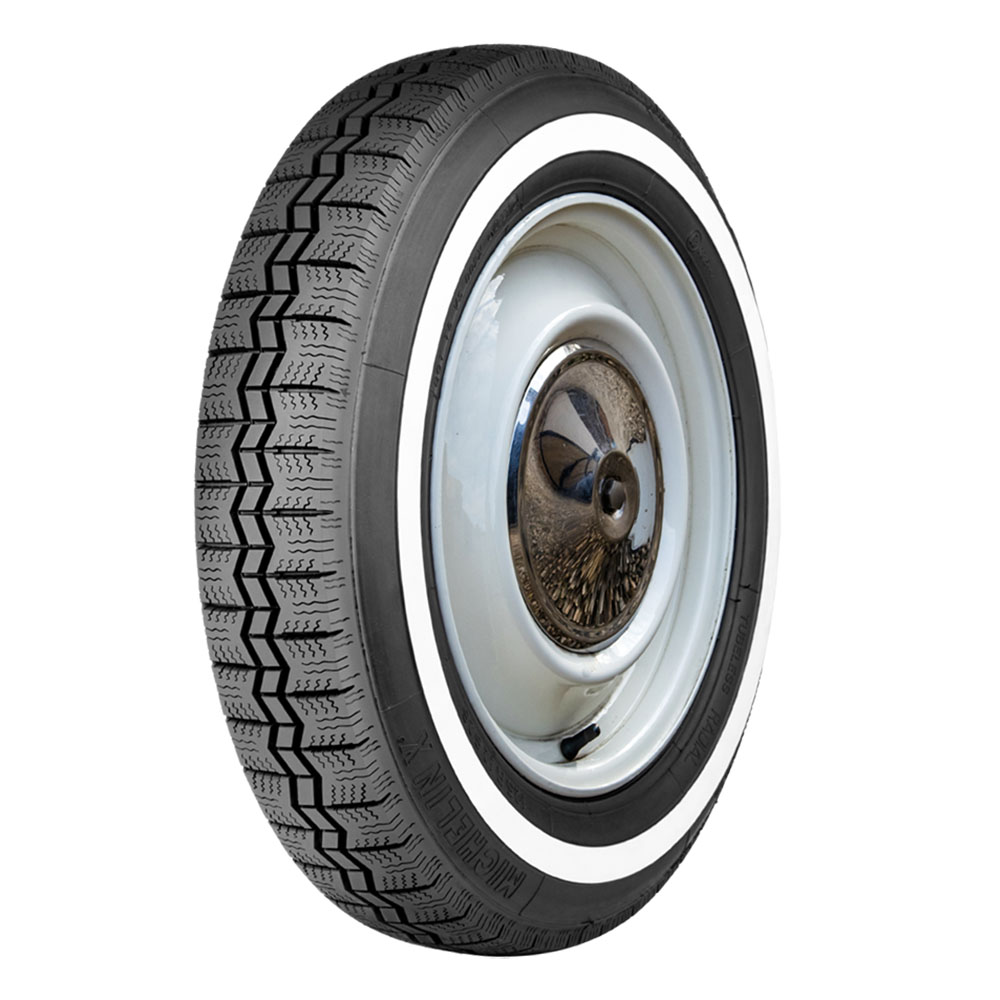
125R15 68S TL X Radial Blackwall Tire
In 1949, Michelin set out to dominate the tire market with a considerable advance in technology. Its revolutionary radial construction of the Michelin X and later the Michelin X-Stop featured the special feature of separating the sidewall function from the crown function. The first major innovation from Michelin, the radial tire was first marketed as the "X" tire in 1949. The advantages of the radial Michelin X tire compared with the cross-ply tire could be clearly seen in all areas. Radial construction offered greater safety, grip and braking performance. Radials also proved economical to use, with double the wear mileage and a considerable reduction in fuel consumption. Drivers enjoyed increased comfort levels thanks to the flexibility of the sidewalls.
Blackwall Tire
Since the introduction of carbon black rocked the tire industry, the original recipe for most tires has been a solid black sidewall. For classics and collector cars alike, it's hard to beat the no-nonsense appeal of a classic blackwall style tire. British sports car, classic truck and even hot rod enthusiasts love the way a nice period correct blackwall tire looks on their vehicles.
S Speed Rating
S Speed Rated: Up to 112 mph (180 km/h). Often required OE for higher performance trim level classic automobiles.
Michelin X Radial
The MICHELIN X tire has a revolutionary radial construction with the special feature of separating the sidewall function from the crown function. The advantages of the radial tire compared to the conventional tire can be seen in all areas: Significantly improved road holding, grip and braking. Economy in use: mileage efficiency doubled, significant reduction in fuel consumption. Great comfort thanks to the flexibility of the sidewalls. The first major Michelin innovation, the radial ply tire, was marketed under the name "Michelin Radial X" in 1949. The X equips different categories of cars: from the original and popular 2CV or Coccinelle to the fascinating Mercedes 190 SL or Facel Vega.
Michelin Brand Classic Tires
Michelin is known for its high quality tires, and we keep thousands of popular Michelin tires in stock every day. Our Michelin product offerings include fitments from the 1920's all the way into the 2000's, with an intense focus on classic sports cars. Build quality, fitment options and period correct styling makes the Michelin product line a favorite among sports car enthusiasts around the world.
Please Note
- Tire mounted on wheel for demonstration purposes only. Wheel and other accessories are not included. Please note that dimensions listed (tread width, section width and overall diameter) are non-scientific and based on an inflated tire, mounted to a wheel. Dimensions may vary due to rim width and inflation pressure.
| SKU | 55590 |
|---|---|
| Weight | 12.000000 |
| Brand | Michelin |
| Product Size | 125R15 68S TL |
| Tube Type or Tubeless | Tubeless |
| Rim Diameter | 15 inch |
| Tire Construction | Radial |
| Tire Series | Michelin X Radial |
| Speed Rating | S |
| DOT Approved | Yes |
| Width Radial | 125 mm |
| Sidewall Style | Blackwall |
| Radial Aspect Ratio | 80 |
| Load Index | 68 |
| Service Description | 68S |
| Section Width (IN) | 4.7 |
| Rim Width (in) | 3.50 - 4.50 |
| Overall Diameter (IN) | 23.2 |
| Availability Date | 2026-12-04T00:00:00Z |
This Michelin X Radial | 125R15 68S comes in the 125R15 size, suitable for the classic and collector vehicles listed below.
About the 125R15 Tire Size
The 125R15 tire size is the size associated with Michelin X Radial | 125R15 68S. On this Product Detail Page, the 125R15 size helps connect the product to vehicle applications commonly searched through tire-size fitment research.
For more detailed tire size and vehicle fitment information, explore the 125R15 tire on the Coker Tire Fitment Guide.
Frequently Asked Questions
Purchase Considerations ▼
Will the Michelin X Radial 125R15 68S work with my existing wheel setup? ▼
The Michelin X Radial 125R15 68S is designed for vehicles with compatible 15-inch wheels and the specified 125R15 tire size. Check your vehicle's original tire specifications and confirm that the wheel is suitable for this application, as matching the wheel diameter alone does not guarantee compatibility.
Also inspect the wheels for corrosion, damage, or problems around the bead area, particularly because this is a tubeless tire. If your vehicle has original or modified wheels, an experienced vintage tire installer can help verify that the combination is suitable.
Are there any brake or suspension clearance considerations when installing the Michelin X Radial 125R15 68S? ▼
The Michelin X Radial 125R15 68S has a narrow, period-correct profile, but its dimensions alone cannot guarantee adequate clearance. Brake conversions, aftermarket suspension components, modified ride height, and non-original wheels can all affect the available space.
Before installation, check clearance with the steering turned fully in both directions and the suspension loaded. The tire should not contact brake components, control arms, steering hardware, or fender structures, especially if you are replacing a different tire size.
Is the Michelin X Radial 125R15 68S suitable for the way I drive my classic vehicle? ▼
The Michelin X Radial 125R15 68S is suited to classic-car use where comfortable road driving and period-appropriate handling are priorities. Its radial construction was developed to improve road holding, grip, braking, fuel efficiency, and ride comfort compared with conventional cross-ply tires.
It can be considered for weekend cruising, regular street driving, club events, and touring, provided its specifications match the vehicle. Owners looking for contemporary high-performance handling should remember that this tire was developed around the requirements of classic vehicles. Alignment, suspension condition, steering components, and correct inflation also influence how it performs.
How might the Michelin X Radial 125R15 68S affect the steering feel of my classic vehicle? ▼
The Michelin X Radial 125R15 68S has a narrow profile and flexible sidewalls, characteristics associated with the classic radial design. Compared with a substantially wider replacement tire, its proportions may help retain steering characteristics closer to those intended for vehicles designed around narrower tires, particularly those without power steering.
Actual steering effort and response will also depend on the vehicle's alignment, suspension, steering components, wheel condition, and tire pressure. Comparing its dimensions with the original tire specification is a useful way to assess whether it suits your vehicle.
Fitment & Compatibility ▼
Which types of classic vehicles commonly use the Michelin X Radial 125R15 68S? ▼
The Michelin X Radial 125R15 68S is associated with compact European classics that used narrow 15-inch radial tires. Its historical applications include vehicles such as the Citroën 2CV, Volkswagen Beetle, Mercedes 190 SL, and Facel Vega, although exact factory tire sizes varied between models and versions.
Its narrow profile and period-correct blackwall styling make it relevant to restoration projects where original proportions and early radial technology are important. Check your vehicle's factory specifications before ordering to confirm that the 125R15 size is appropriate.
Is the Michelin X Radial 125R15 68S a good choice for an authenticity-focused restoration? ▼
The Michelin X Radial 125R15 68S is a strong option for restorations where period-correct radial technology and original-style proportions matter. Michelin introduced its X radial tire in 1949, making this design historically significant for vehicles associated with the transition to radial construction.
Its narrow profile, traditional blackwall appearance, and radial construction help retain the character of classic European vehicles. For an authenticity-focused project, compare the tire with documented factory specifications for the specific model, year, market, and trim.
Tire Size Equivalents & Conversions ▼
Why is matching the original Michelin X Radial 125R15 68S size important for restoration projects? ▼
Matching the original tire size helps preserve the proportions and driving characteristics intended for the vehicle. A change in tire dimensions can affect ride height, speedometer accuracy, wheel-well clearance, and the overall visual balance of a classic car.
For restoration projects, retaining the specified 125R15 size can also help maintain the period-correct appearance associated with the Michelin X Radial. Check the vehicle's original specifications rather than relying on wheel diameter alone when confirming the correct fitment.
What should I measure before replacing another tire size with the Michelin X Radial 125R15 68S? ▼
Before switching to the Michelin X Radial 125R15 68S, check your wheel diameter and width, the dimensions of your current tires, and the available space inside the wheel wells. Comparing these measurements with the replacement tire helps establish whether it is suitable for your vehicle.
Also inspect clearance around the suspension, steering components, and fender openings. Account for steering movement and suspension compression rather than checking only the vehicle's stationary position. These checks can help prevent rubbing and unexpected fitment problems after installation.
Performance & Use Case ▼
Does the Michelin X Radial 125R15 68S provide good wet-weather performance? ▼
The Michelin X Radial was developed to improve road holding, grip, and braking compared with conventional cross-ply tires. Its radial construction was a significant advancement in tire technology, offering improved contact with the road and more predictable driving characteristics.
Actual wet-weather performance will depend on tread condition, inflation pressure, vehicle condition, and driving inputs. Keep the tire properly maintained and adjust driving to the road conditions rather than assuming its historical radial design provides the same performance as a modern wet-weather tire.
Is the Michelin X Radial 125R15 68S intended for performance driving or authenticity-focused driving? ▼
The Michelin X Radial 125R15 68S is primarily suited to classic-car owners who value period-correct fitment, comfortable road use, and historically significant tire technology. Its radial construction was designed to improve grip, braking, efficiency, and comfort compared with earlier cross-ply designs.
It is better understood as a restoration-oriented road tire than a modern high-performance option for aggressive driving. Its narrow proportions and traditional blackwall appearance also make it a natural choice for enthusiasts looking to preserve the original character of a classic vehicle.
Construction, Durability & Load Capacity ▼
How does radial construction in the Michelin X Radial 125R15 68S influence tread life? ▼
Radial construction was one of Michelin's major innovations, with the X tire introduced in 1949. Compared with conventional cross-ply tires, the design offered improved mileage efficiency, with Michelin highlighting the potential for double the tread mileage.
Actual tread life will depend on factors such as inflation pressure, alignment, driving habits, and vehicle condition. Regularly checking tire pressure and addressing uneven wear can help maintain consistent performance and make the most of the tire's radial construction.
How durable is the Michelin X Radial 125R15 68S for regular collector-car use? ▼
The Michelin X Radial was developed to offer improved mileage efficiency and everyday usability compared with earlier cross-ply tire designs. Its radial construction also provides the road holding and comfort benefits that helped establish radial tires as a major advancement in the automotive industry.
For regular collector-car use, durability will depend on maintaining correct inflation, staying within the tire's load and speed ratings, and inspecting it for wear or aging. Vehicles that spend long periods parked should receive periodic tire checks, even when they are not being driven frequently.
Installation & Maintenance ▼
What should I verify before installing the Michelin X Radial 125R15 68S on my vehicle? ▼
Confirm that the Michelin X Radial 125R15 68S matches your vehicle's required tire size and that the wheels are suitable for a 15-inch tire. Comparing the replacement size with the original specifications helps avoid problems with fitment, clearance, and vehicle proportions.
Inspect the wheels for corrosion, bending, or damage around the bead area, as these can affect how a tubeless tire seats and seals. Also check the steering and suspension components and confirm that there is sufficient clearance around the tire before driving.
What maintenance issues should I monitor after installing the Michelin X Radial 125R15 68S? ▼
After installation, regularly monitor inflation pressure, tread wear, and any changes in ride quality or steering response. Uneven wear can indicate alignment or suspension problems, while vibration may point to an imbalance or an issue with the wheel assembly.
Also pay attention to tire clearance, particularly if your vehicle has modified suspension or non-original wheels. Periodic inspections for aging, visible damage, and pressure loss are especially important for collector cars that spend extended periods in storage.
Write Your Own Review
OTHER STUFF YOU MAY LIKE
Check items to add to the cart or

More Tires This Size