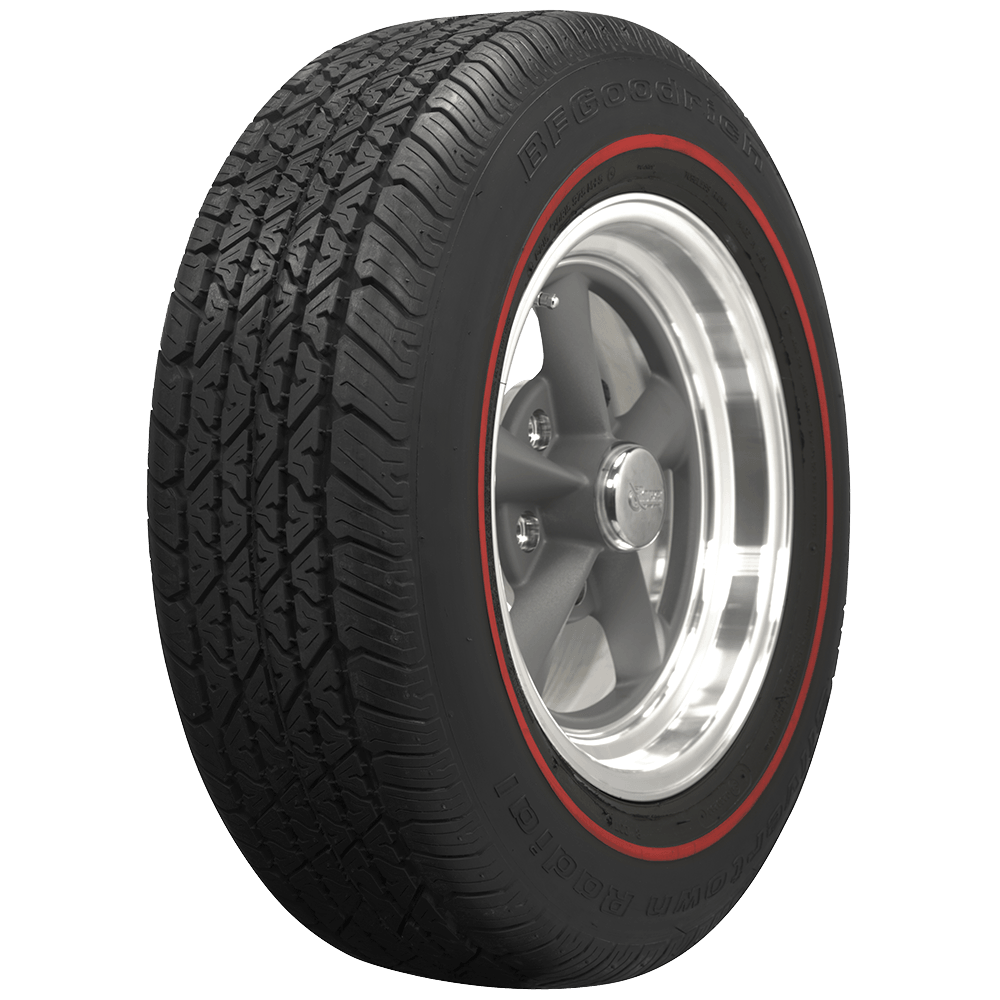
215/70VR14 92W TL XWX Blackwall Tire
The only radial tire which could be fitted on the fastest cars in the world in the 1970s, the Michelin XWX gives these high speed vehicles outstanding road holding ability and remarkable grip. Michelin XWX tires featured construction designed to reach an incredible 186 mph top speed. The special features of the XWX result in remarkable performance, combining speed, driving pleasure and safety. The original design of its internal construction, together with its flexible carcass give exceptional comfort when traveling at very high speeds. Being a VR category tire, the XWX can be used at speeds in excess of 210 kph (131 mph) ; with a maximum speed of 270 kph (155 to 186 mph). At the end of the 1960s, Germany and Italy were the leaders in the European motorway development program and were also the main producers of cars which could reach speeds in excess of 200 km/h, (124 mph). The wide asphalt strips and the absence of speed limits offered a privileged few the opportunity to make full use of the performance of these "super-cars" at speeds which would be unthinkable today. The Lamborghini Miura (1966), Ferrari 365 (1965), Maserati Ghilbi (1966) ; de Tomaso Pantera (1970) and Porsche 911 Carrera RS (1972) were the undisputed stars, but the large German saloons like the Mercedes 300 SE 6,31 (1968) and BMW 3.0 SI (1971) also made a strong impression. The French were also in the high speed game with the Citroen SM (1970) as were the British with the legendary Jaguar V12 E-Type (1970) and Aston Martin DBS (1967).
Blackwall Tire
Since the introduction of carbon black rocked the tire industry, the original recipe for most tires has been a solid black sidewall. For classics and collector cars alike, it's hard to beat the no-nonsense appeal of a classic blackwall style tire. British sports car, classic truck and even hot rod enthusiasts love the way a nice period correct blackwall tire looks on their vehicles.
W Speed Rating
W Speed Rated: Up to 168 mph (270 km/h). Often required OE for very high performance trim level automobiles. This is an important consideration for restored and modified classic cars (Resto-Mods) where drastically improved performance over OE is added.
Michelin XWX
The tire for 70s supercars with fitments for BMW, Porsche, Mercedes, Jaguar, Cadillac Seville and others. The special architecture of the XWX ensures it delivers high performance that combines speed, driving pleasure and safety.
Michelin Brand Classic Tires
Michelin is known for its high quality tires, and we keep thousands of popular Michelin tires in stock every day. Our Michelin product offerings include fitments from the 1920's all the way into the 2000's, with an intense focus on classic sports cars. Build quality, fitment options and period correct styling makes the Michelin product line a favorite among sports car enthusiasts around the world.
Please Note
- Tire mounted on wheel for demonstration purposes only. Wheel and other accessories are not included. Please note that dimensions listed (tread width, section width and overall diameter) are non-scientific and based on an inflated tire, mounted to a wheel. Dimensions may vary due to rim width and inflation pressure. Please note Chemical Guys Tire and Rubber Cleaner and Adams Polish Tire shine has been linked to Whitewall browning and should not be used. We recommend using our line of tire care products.
| SKU | 555773 |
|---|---|
| Weight | 30.000000 |
| Availability Date | 2026-02-27T00:00:00Z |
| Brand | Michelin |
| Tire Series | Michelin XWX |
| Product Size | 215/70VR14 92W TL |
| Sidewall Style | Blackwall |
| Rim Diameter | 14 inch |
| Overall Diameter (IN) | 26.4 |
| Section Width (IN) | 8.8 |
| Width Radial | 215 mm |
| Radial Aspect Ratio | 70 |
| Rim Width (in) | 5.50 - 7.50 |
| Tire Construction | Radial |
| Tube Type or Tubeless | Tubeless |
| DOT Approved | Yes |
| Service Description | 92W |
| Load Index | 92 |
| Speed Rating | W |
This Michelin XWX | 215/70VR14 comes in the 215/70R14 size, suitable for the classic and collector vehicles listed below.
About the 215/70R14 Tire Size
The 215/70R14 is a radial tire size associated with select vehicle applications from 1977 through 2000, including Mercedes-Benz, Ford, Mercury, Mazda Trucks, Nissan Trucks, and Toyota Trucks models. On this product page, Michelin XWX | 215/70VR14 connects that 215/70R14 size to a period-correct radial fitment search for these vehicles. For more detailed information on this tire size, explore the 215/70R14 tire on Coker Tire Fitment Guide.
Vehicle Fitment for the Michelin XWX | 215/70VR14
The Michelin XWX | 215/70VR14 is available in a tire size associated with a range of classic and collector vehicles. The vehicle applications below are organized by year, make, and model to help identify vehicles associated with the 215/70R14 size. Explore the linked Make & Model and Year Make & Model pages for more detailed fitment information.
Fitment information should be verified for the specific vehicle before purchase. Confirm tire size, wheel fit, load requirements, overall diameter, and available clearance.
1976–19801 make · 3 fitments
The 1976–1980 period includes Mercedes-Benz applications associated with the 215/70R14 size. These fitments center on the 6.9 across the late 1970s.
Mercedes-Benz
Mercedes-Benz applications in this period include the 6.9.
1981–19852 makes · 2 fitments
The 1981–1985 period includes a small group of 215/70R14 applications spanning Ford and Mercury. These applications are focused on Thunderbird and Cougar models.
Ford
Ford applications in this period include the Thunderbird.
Mercury
Mercury applications in this period include the Cougar.
1986–19905 makes · 16 fitments
The 1986–1990 period includes a broader mix of 215/70R14 applications across Ford, Mercury, Ford Minivans, and Ford Trucks. These fitments cover passenger-car, minivan, and truck applications within this span.
Ford
Ford applications in this period include the Taurus and Thunderbird.
Mercury
Mercury applications in this period include the Cougar and Sable.
Ford Minivans
Ford Minivans applications in this period include the Aerostar.
Ford Trucks
Ford Trucks applications in this period include the Ranger.
Ford Minivans
Ford Minivans applications in this period include the Aerostar.
1991–19953 makes · 15 fitments
The 1991–1995 period includes a broad set of 215/70R14 applications spanning Ford Minivans, Ford Trucks, and Mazda Trucks. The range expands from Aerostar and Ranger fitments into several Mazda truck models.
Ford Minivans
Ford Minivans applications in this period include the Aerostar.
Ford Trucks
Ford Trucks applications in this period include the Ranger.
Mazda Trucks
Mazda Trucks applications in this period include the B2300, B3000, and B4000.
1996–20005 makes · 14 fitments
The 1996–2000 period includes the widest spread of 215/70R14 applications, spanning Ford Minivans, Ford Trucks, Mazda Trucks, Nissan Trucks, and Toyota Trucks. These fitments cover several light-truck and utility-focused models through 2000.
Ford Minivans
Ford Minivans applications in this period include the Aerostar.
Ford Trucks
Ford Trucks applications in this period include the Ranger.
Mazda Trucks
Mazda Trucks applications in this period include the B2300, B3000, and B4000.
Nissan Trucks
Nissan Trucks applications in this period include the Pickup.
Toyota Trucks
Toyota Trucks applications in this period include the Tacoma.
Frequently Asked Questions
Fitment & Compatibility ▼
Can the Michelin XWX 215/70VR14 be used on vehicles with upgraded brakes? ▼
Upgraded disc brakes or larger rotors can reduce the clearance inside the wheel barrel. The Michelin XWX 215/70VR14’s 8.8-inch section width requires sufficient spacing to prevent caliper interference. Verify wheel offset and hub clearance if brakes are larger than factory specifications.
Maintaining recommended rim widths and inflation pressures ensures consistent tire geometry. Proper clearance checks prevent rubbing, uneven wear, and potential safety issues, while keeping the tire’s historic fitment appearance intact.
Tire Size Equivalents & Conversions ▼
What are the metric and alpha-numeric equivalents of Michelin XWX 215/70VR14? ▼
The Michelin XWX 215/70VR14 combines metric width (215 mm) with a radial aspect ratio (70%) and 14-inch rim diameter. The "VR" indicates a radial design suitable for speeds up to the W-rated maximum. Alpha-numeric equivalents in vintage terminology may be 82-14 or 86VR14 depending on historical charts, but the metric measurement remains the most accurate.
Converting these values ensures fitment on vehicles designed with both vintage and modern specifications. Maintaining exact width, aspect ratio, and rim diameter is crucial for original stance, correct speedometer readings, and tire load distribution.
Performance & Use Case ▼
How will the Michelin XWX 215/70VR14 drive on highways? ▼
The Michelin XWX 215/70VR14 provides stable, predictable highway performance with smooth absorption of imperfections due to its radial construction and 70% aspect ratio. Sidewall flex aids comfort, while the 92W service rating ensures the tire can handle standard highway speeds safely.
High-speed stability is enhanced by proper inflation and rim width matching. Slight steering effort increase may be felt with wider rims, but overall handling remains compliant for vintage muscle cars and classic vehicles on modern roads.
Can the Michelin XWX 215/70VR14 support heavier vintage vehicles? ▼
The 92 load index supports a maximum load consistent with medium-weight classic cars. Vehicles approaching the upper limit should monitor tire pressure closely to avoid sidewall stress and heat accumulation during extended highway drives.
Matching the correct rim width and maintaining even load distribution preserves tire longevity. Overloading or uneven vehicle weight may lead to irregular wear or reduced braking response, impacting safety.
How does the Michelin XWX 215/70VR14 perform under repeated highway heat cycles? ▼
The radial structure of the Michelin XWX dissipates heat efficiently under continuous driving. Maintaining correct inflation and adhering to load ratings prevents excessive heat buildup, which could compromise rubber longevity and sidewall integrity.
Avoid prolonged overloading or under-inflation. Proper tire monitoring preserves both driving comfort and the historical authenticity of the vehicle’s stance.
Construction, Durability & Load Capacity ▼
What type of construction does the Michelin XWX 215/70VR14 use? ▼
The Michelin XWX 215/70VR14 uses radial construction, indicated by the "R" in the size code. Radial tires provide flexible sidewalls with a steel-belted body, offering a balance between ride comfort, handling precision, and heat dissipation on highways.
This construction ensures consistent contact patch behavior and predictable flex, preserving the tire’s intended stance and grip on both street and light performance applications.
How durable is the Michelin XWX 215/70VR14 for long-term use? ▼
Radial design and high-quality Michelin compounds contribute to long service life, assuming correct inflation and load management. Regular monitoring for wear, rotation, and alignment is recommended to prevent uneven tread degradation.
Durability also depends on avoiding prolonged high-speed heat cycles and excessive curb contact. Proper care preserves both function and original appearance for years.
Installation & Maintenance ▼
Are there special care considerations for Michelin XWX 215/70VR14 sidewalls? ▼
Blackwall styling avoids whitewall or redline concerns, but chemical cleaners like tire polish may affect finish or rubber compounds. Using recommended tire care products prevents discoloration or premature aging.
Maintaining correct inflation and avoiding prolonged curb contact preserves sidewall shape. This ensures both aesthetic and functional longevity.
How should the Michelin XWX 215/70VR14 be rotated? ▼
Standard rotation patterns for radial tires are recommended to promote even tread wear. Front-to-rear rotation helps maintain consistent contact patch performance, steering feedback, and longevity.
Rotation intervals should follow vehicle and tire manufacturer guidance. Proper rotation prevents uneven wear, heat buildup, and sidewall stress while preserving vintage ride quality.
How to clean Michelin XWX 215/70VR14 without damage? ▼
Use only recommended tire cleaners to prevent rubber degradation or discoloration. Harsh chemical polishes may affect the blackwall finish or lead to browning. Gentle brushing and rinsing maintain both appearance and structural integrity.
Proper care ensures radial sidewalls remain resilient, tread remains compliant, and aesthetic authenticity is preserved for classic vehicle presentation.
What is the expected service life of Michelin XWX 215/70VR14? ▼
Under proper inflation, load adherence, and regular maintenance, Michelin XWX 215/70VR14 offers years of service, retaining structural integrity and ride comfort. Durability depends on avoiding prolonged high-speed heat cycles and ensuring suspension clearance.
Regular inspection for wear patterns, sidewall cracks, or pressure fluctuations preserves performance and prevents unexpected failures while maintaining authenticity for classic vehicle use.
Write Your Own Review
More Tires This Size