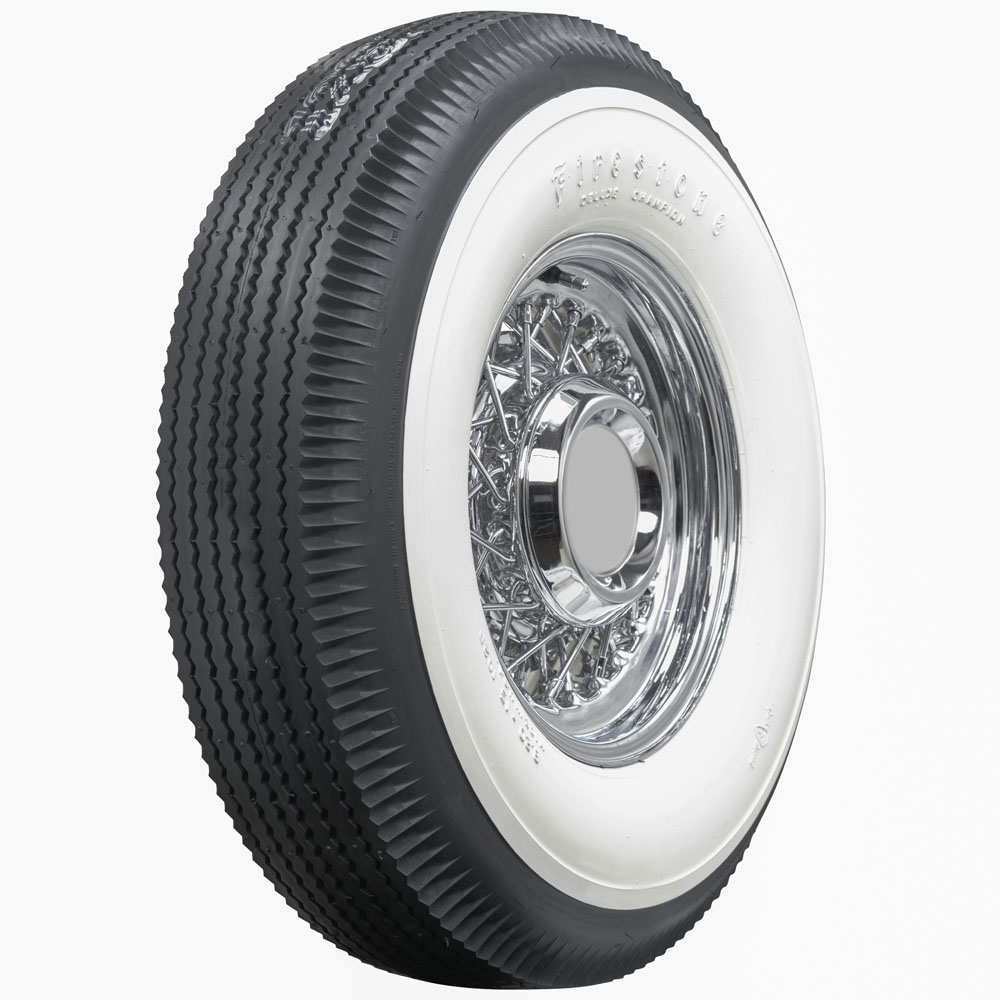
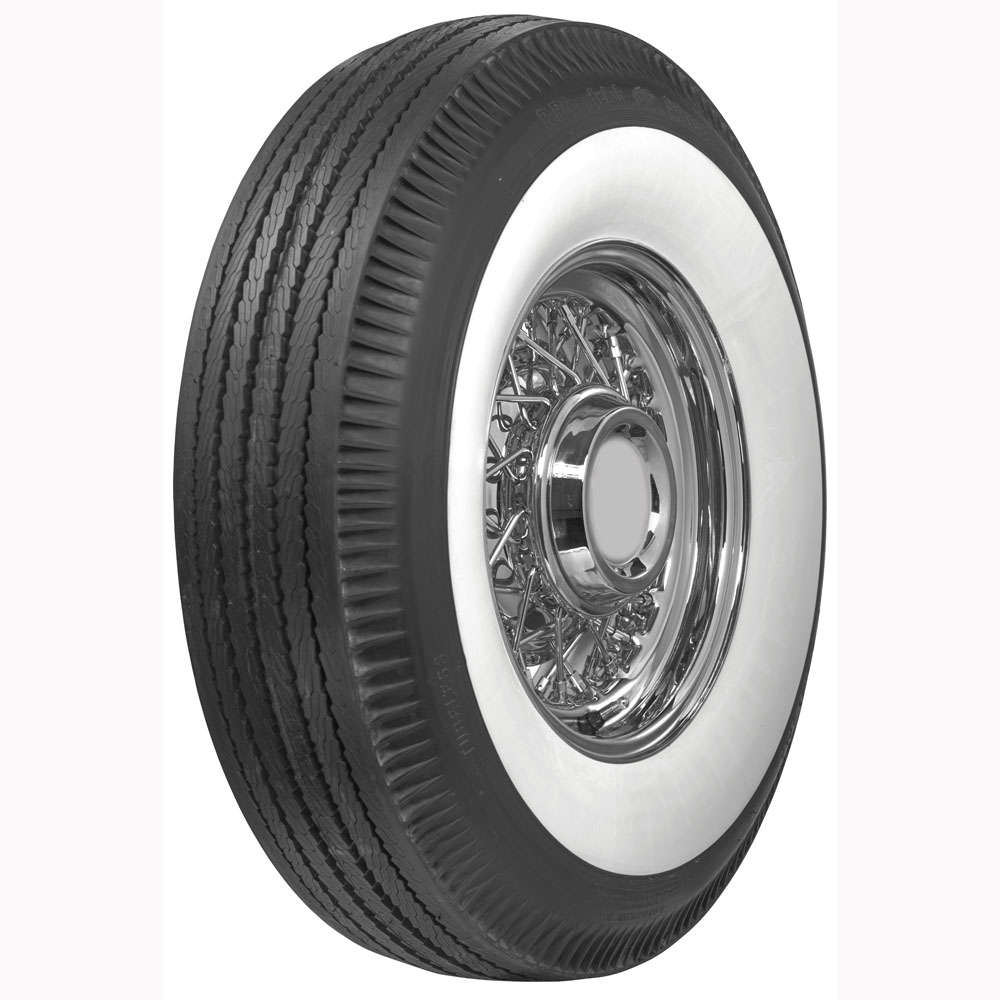
820-15 Universal Classic Wide Whitewall Tire
Factory production white wall tire commonly found on many American automobiles manufactured 1953 to 1956. Most popular on Cadillacs, Buicks, Lincolns and other full bodied cars.Features:"Fluted" shoulderOriginal Tread design Made in USA.
Genuine Wide Whitewall Tire
Typically wide whitewalls run all the way to the bead. Narrow whitewalls will stop somewhere before the bead, resulting in a narrower band of exposed white rubber. Bright white rubber is added directly to the tire sidewall during initial construction of the carcass, resulting in a truly integrated, high-quality product after vulcanization. This style was popular into the early sixties, eventually being replaced by narrow whitewalls altogether.
Bias Ply Construction
Bias ply tire construction is a method that was used from the 1900's through the 1970's on passenger cars and light trucks. Bias ply tires feature ply cords that run at a 45 degree angle to the bead, and overlap in a crisscross pattern, depending on how many ply layers are used. This creates a strong tire, but bias ply tires have a tendency to follow breaks or ruts in the pavement. Bias ply tires are the most authentic choice for classic car restorations and traditional hot rod builds. Coker Tire offers a huge variety of bias ply tires for many applications.
Universal Classic Bias Ply Tires
Universal Classic bias ply tires are available in several popular sizes to fit cars from the 1930’s through the 1960’s. The tires feature a period correct tread pattern and sidewall style, giving you the perfect original look for your classic car.
Universal Vintage Tires
With 70 sizes and styles, the Universal Vintage Tire product line features authentic styles and sizes. These tires fit a wide range of classic cars, from 1900's antiques to 1970's sports cars. You'll find Universal tires with a whitewall, black sidewall and redline for many classic car fitments. Also included in the Universal line are a couple of very affordable options for the famous Ford Model A.
Please Note
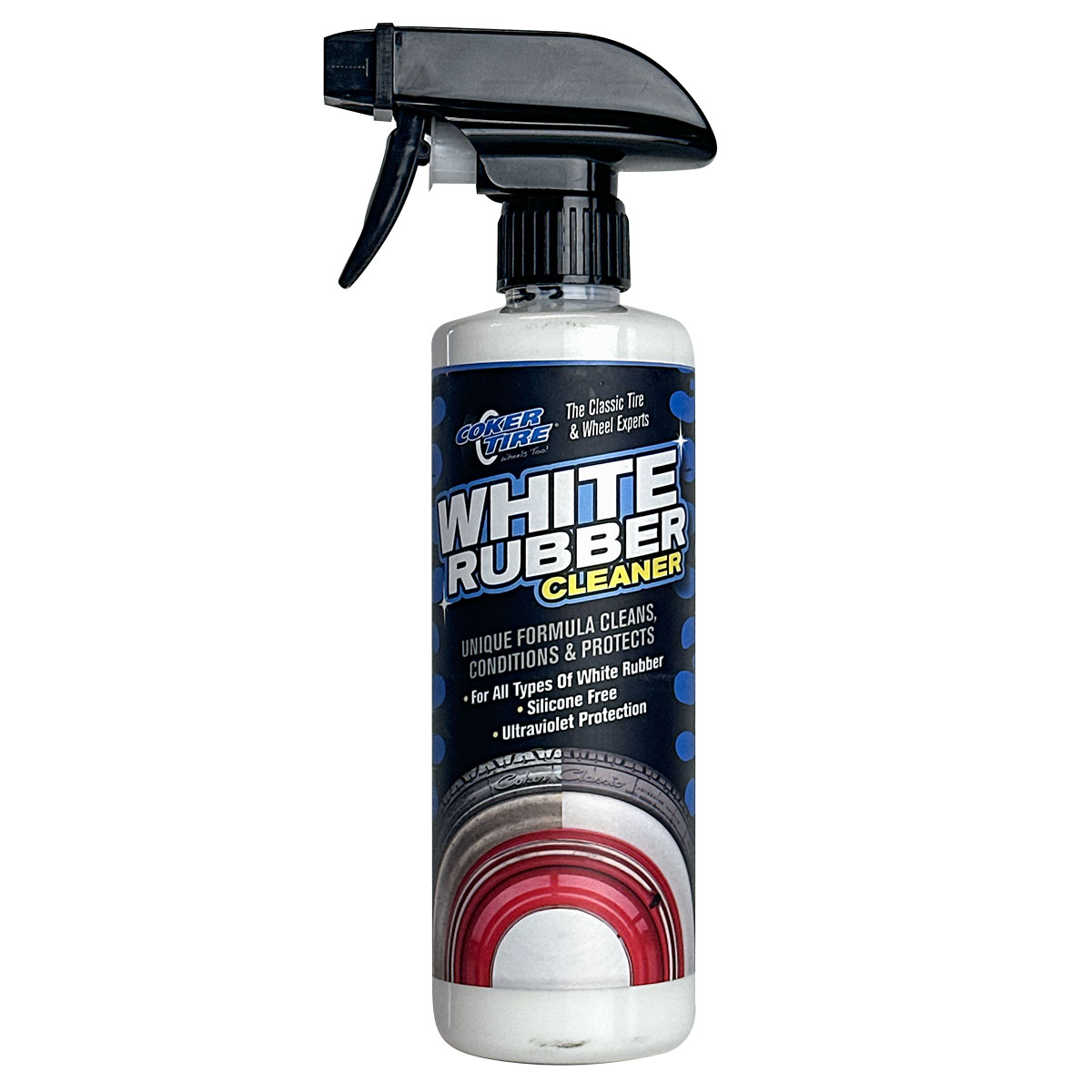
- Tire mounted on wheel for demonstration purposes only. Wheel and other accessories are not included. Please note that dimensions listed (tread width, section width and overall diameter) are non-scientific and based on an inflated tire, mounted to a wheel. Dimensions may vary due to rim width and inflation pressure. Please note Chemical Guys Tire and Rubber Cleaner and Adams Polish Tire shine has been linked to Whitewall browning and should not be used. We recommend using our line of tire care products.
| SKU | 61966 |
|---|---|
| Weight | 30.000000 |
| Availability Date | 2025-02-28T00:00:00Z |
| Sidewall Style | Wide Whitewall |
| Whitewall Width (in) | 3.500 |
| Tire Construction | Bias Ply |
| Tire Series | Universal Classic Bias Ply |
| Rim Diameter | 15 inch |
| Tube Type or Tubeless | Tube Type |
| Product Size | 820-15 |
| Width Bias Ply | 8.20 |
| Brand | Universal Vintage Tire |
This Universal 3.50 Inch Wide Whitewall comes in the 820-15 size, suitable for the classic and collector vehicles listed below.
About the 820-15 Tire Size
The 820-15 is a bias ply tire size associated with a wide range of late-1940s through 1960s luxury and premium vehicle applications, spanning 1948 through 1969. This Universal 3.50 Inch Wide Whitewall comes in that 820-15 size, pairing the listed fitments with a 3.50 inch wide whitewall appearance and bias ply construction. For more detailed information on this tire size, explore the 820-15 tire on Coker Tire Fitment Guide.
820-15 Tire Size Alternatives
| Alternative Type | Tire Size | More Information | Products |
|---|---|---|---|
| Modern Radial Equivalent | 235R15 | 235R15 Tire Fitment Guide | 235R15 Products for Sale |
| Modern Radial Equivalent | P235/75R15 | P235/75R15 Tire Fitment Guide | P235/75R15 Products for Sale |
| Modern Radial Equivalent | P255/70R15 | P255/70R15 Tire Fitment Guide | P255/70R15 Products for Sale |
| Modern Radial Equivalent | 820R15 | 820R15 Tire Fitment Guide | 820R15 Products for Sale |
Vehicle Fitment for the Universal 3.50 Inch Wide Whitewall | 820-15
The Universal 3.50 Inch Wide Whitewall | 820-15 is available in a tire size associated with a range of classic and collector vehicles. The vehicle applications below are organized by year, make, and model to help identify vehicles associated with the 820-15 size. Explore the linked Make & Model and Year Make & Model pages for more detailed fitment information.
Fitment information should be verified for the specific vehicle before purchase. Confirm tire size, wheel fit, load requirements, overall diameter, and available clearance.
1948–19509 makes · 25 fitments
The 1948–1950 period includes a broad mix of 820-15 applications across Buick, Cadillac, Chrysler, De Soto, Dodge, Lincoln, Oldsmobile, Packard, and Buick-related luxury car lines. These applications show the 820-15 size across a varied group of late-1940s and 1950 model-year vehicles.
Buick
Buick applications in this period include the 70 Roadmaster and 79 Series.
Cadillac
Cadillac applications in this period include the 60 Series, 61 Series, 62 Series, and 75 Series.
Chrysler
Chrysler applications in this period include the New Yorker & Saratoga C39, Royal & Windsor C38, New Yorker & Saratoga C46, and New Yorker & Saratoga C49.
Oldsmobile
Oldsmobile applications in this period include the Deluxe 98 and 98 Series.
Dodge
Dodge applications in this period include the 7 Passenger, Deluxe 6, and D 34.
Lincoln
Lincoln applications in this period include the EH and EL.
Packard
Packard applications in this period include the Convertible & Custom, Super, Custom, and Super 8.
De Soto
De Soto fitment in this period is represented by the S 14.
1951–195510 makes · 41 fitments
The 1951–1955 period covers an especially wide spread of 820-15 applications across American luxury makes along with Bentley, Rolls Royce, and Volvo. These fitments show strong coverage for the 820-15 size during the early- to mid-1950s.
Cadillac
Cadillac applications in this period include the 75 Series, 7500 Series, 60 Series, 62 Series, and 60S Series.
Chrysler
Chrysler applications in this period include the Imperial, New Yorker, New Yorker C52 & Imperial C54, Saratoga, Windsor, Custom Imperial, and Chrysler Imperial.
De Soto
De Soto applications in this period include the S 15, S 15-6, S 17-8, and S 18-8.
Lincoln
Lincoln applications in this period include the EH, Convertible, Capri, and Cosmo.
Dodge
Dodge fitment in this period is represented by the D 42.
Imperial
Imperial applications in this period include the C56, C64, and C69.
Packard
Packard applications in this period include the 2626 Series and 5426 Series.
Volvo
Volvo fitment in this period is represented by the PV 831.
Bentley
Bentley fitment in this period is represented by the S-Type.
Rolls Royce
Rolls Royce fitment in this period is represented by the Silver Cloud.
1956–19605 makes · 38 fitments
The 1956–1960 period includes extensive 820-15 applications across Bentley, Cadillac, Chrysler, Imperial, Lincoln, and Rolls Royce. This range reflects broad use of the 820-15 size on luxury and upper-series vehicles in the late 1950s and 1960 model year.
Bentley
Bentley applications in this period include the S-Type, S2, and S3.
Cadillac
Cadillac applications in this period include the 60 Series, 62 Series, 75 Series, 60S Series, Eldorado, and 86 Series.
Chrysler
Chrysler applications in this period include the Crown Imperial and Imperial.
Imperial
Imperial applications in this period include the C70, C73, Crown, Custom, and Le Baron.
Lincoln
Lincoln applications in this period include the Capri and Premiere.
Frequently Asked Questions
Fitment & Compatibility ▼
What wheel widths are compatible with the Universal 3.50 Inch Wide Whitewall 820-15? ▼
The Universal 3.50 Inch Wide Whitewall 820-15 is recommended for wheel widths between 6.0 and 8.0 inches. This range aligns with factory steel wheels used on most 1950s American vehicles.
Using a wheel outside this range can distort the tire’s shape. A narrow wheel may crown the tread and reduce contact patch, while a wider wheel can flatten the profile and alter sidewall appearance. Staying within the correct width ensures proper load distribution and preserves the intended vintage stance.
Will the Universal 3.50 Inch Wide Whitewall 820-15 work with modern wheels? ▼
The Universal 3.50 Inch Wide Whitewall 820-15 can be mounted on modern 15 inch wheels, but compatibility depends on wheel design. Tube type construction requires proper sealing surfaces.
Modern wheels may not always accommodate tubes correctly. Additionally, offset differences can affect fitment and appearance. For best results, original-style wheels are recommended to maintain both function and period-correct aesthetics.
Tire Size Equivalents & Conversions ▼
What modern radial sizes are equivalent to the Universal 3.50 Inch Wide Whitewall 820-15? ▼
The Universal 3.50 Inch Wide Whitewall 820-15 is roughly comparable to radial sizes such as P235/75R15 or 235R15 in overall diameter. These modern equivalents offer similar height but differ in construction.
Radial alternatives typically have a wider footprint and lower sidewall flex. This changes handling and ride characteristics. While radials improve drivability, they do not replicate the original appearance or behavior of a bias ply tire.
What bias ply sizes are similar to the Universal 3.50 Inch Wide Whitewall 820-15? ▼
The Universal 3.50 Inch Wide Whitewall 820-15 is similar to bias ply sizes like L78-15 and 900-15. These sizes were commonly used on large American cars in the 1950s.
These alternatives share similar diameter and load characteristics. However, slight differences in width and profile may affect fitment and appearance. Matching the original specification ensures the most accurate restoration.
Will switching from radial tires to the Universal 3.50 Inch Wide Whitewall 820-15 affect speedometer accuracy? ▼
Switching to the Universal 3.50 Inch Wide Whitewall 820-15 may affect speedometer accuracy if the previous tire had a different overall diameter. Bias ply sizing does not directly translate to metric radial sizes.
Even small diameter differences can change revolutions per mile. This can cause the speedometer to read slightly faster or slower. Checking calibration after installation helps maintain accurate readings.
Performance & Use Case ▼
Is the Universal 3.50 Inch Wide Whitewall 820-15 suitable for daily driving? ▼
The Universal 3.50 Inch Wide Whitewall 820-15 can be used for occasional driving but is not ideal for modern daily use. Bias ply tires require more attention to driving conditions.
They are best suited for show cars, weekend cruising, and restoration purposes. For frequent highway driving, radial alternatives may provide better comfort and safety.
How does the Universal 3.50 Inch Wide Whitewall 820-15 perform in wet conditions? ▼
The narrower contact patch of the Universal 3.50 Inch Wide Whitewall 820-15 results in less braking grip compared to wider radial tires. Bias ply construction also affects stability.
Braking distances may be longer, especially in emergency situations. Maintaining proper brake system condition is important to compensate for these characteristics.
Is the Universal 3.50 Inch Wide Whitewall 820-15 suitable for show-quality restorations? ▼
The Universal 3.50 Inch Wide Whitewall 820-15 is ideal for show-quality restorations. The 3.5 inch whitewall and period-correct design match original factory appearance.
It provides authenticity that radial alternatives cannot replicate. This makes it a top choice for concours-level restorations and historically accurate builds.
Construction, Durability & Load Capacity ▼
How does bias ply construction affect durability in the Universal 3.50 Inch Wide Whitewall 820-15? ▼
Bias ply construction provides strong sidewalls and resistance to impact. This makes the tire suitable for heavy vehicles and rougher road conditions.
However, the design can generate more heat at higher speeds. Proper inflation and moderate driving help maintain durability over time.
Is heat buildup a concern for the Universal 3.50 Inch Wide Whitewall 820-15? ▼
Heat buildup can occur in bias ply tires, especially at higher speeds or with improper inflation. This can affect durability over time.
Maintaining correct pressure and avoiding sustained high-speed driving helps manage heat. These tires are best suited for moderate speeds and controlled driving conditions.
Installation & Maintenance ▼
What tire pressure should I use for the Universal 3.50 Inch Wide Whitewall 820-15? ▼
The Universal 3.50 Inch Wide Whitewall 820-15 requires inflation appropriate for the vehicle weight and original specifications. Bias ply tires are sensitive to pressure changes.
Proper inflation ensures correct contact patch and reduces uneven wear. Overinflation can stiffen the ride, while underinflation increases heat buildup.
Does the Universal 3.50 Inch Wide Whitewall 820-15 require special installation? ▼
The Universal 3.50 Inch Wide Whitewall 820-15 requires installation with an inner tube. Proper mounting techniques are essential to avoid damage.
Ensuring correct tube size and careful handling during installation helps maintain performance. Professional installation is recommended for best results.
How should I clean and maintain the whitewall on the Universal 3.50 Inch Wide Whitewall 820-15? ▼
Cleaning the whitewall requires gentle products designed for vintage tires. Harsh chemicals can cause discoloration.
Regular cleaning preserves appearance and prevents staining. Proper care ensures the whitewall remains bright and authentic.
Write Your Own Review
Popular Add-Ons For Your Order
More Tires This Size