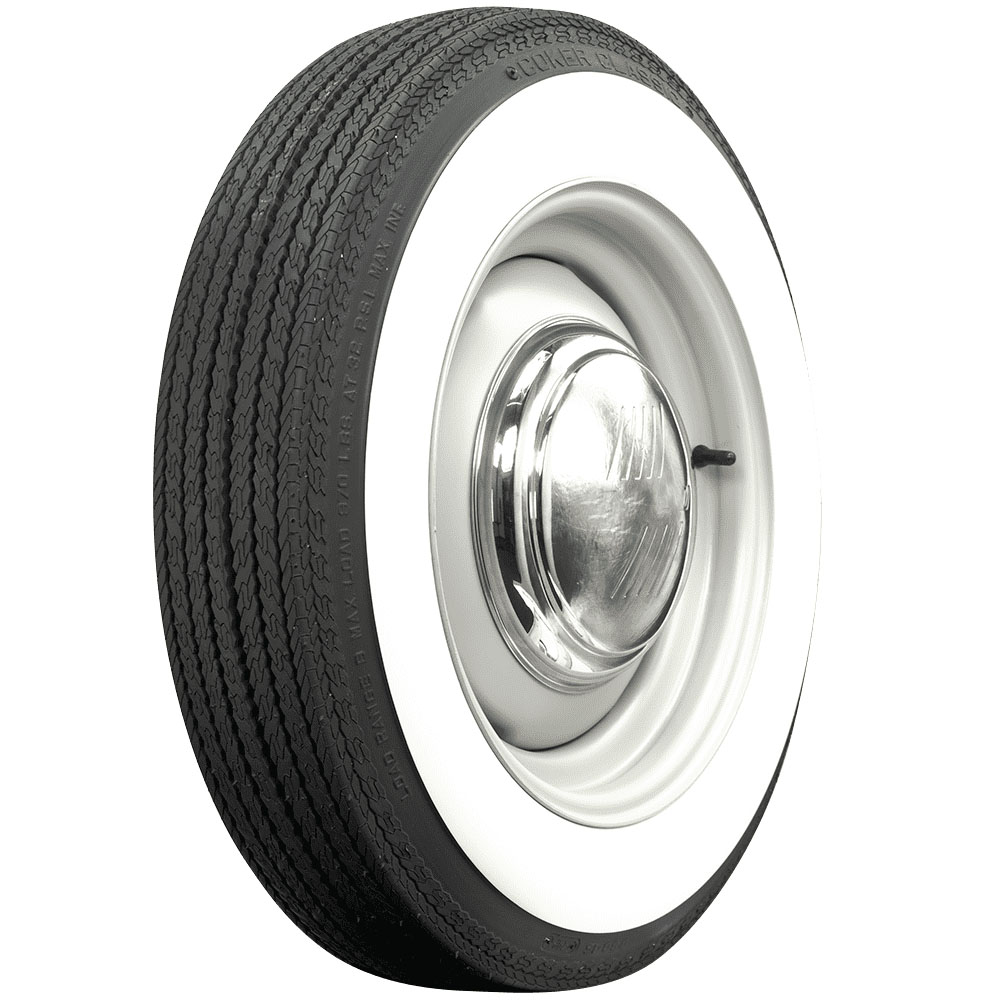
560-15 US Royal Bias Ply Narrow Whitewall Tire
U.S. Royal Narrow Whitewall tires were OE fitments on many of the legendary freeway cruisers of the sixties. Whitewall tires were very popular on the full-size sedans and luxury cars of that era. Coker Tire Company offers a full lineup authentic U.S Royal tires, made in the USA in the original molds and backed by our life of the tread warranty. Please note that dimensions listed tread width, section width and overall diameter are non-scientific and based on an inflated tire, mounted on a wheel. Dimensions may vary due to rim width and inflation pressure. Tread patterns and sidewall styles vary, please click on individual tires below to view photos.
Genuine Narrow Whitewall Tire
Typically wide whitewalls run all the way to the bead. Narrow whitewalls will stop somewhere before the bead, resulting in a narrower band of exposed white rubber. The bright white rubber is added directly to the tire sidewall during initial construction of the carcass, resulting in a truly integrated, high-quality product after vulcanization. This style became popular in the early sixties, eventually replacing wide whitewalls altogether.
Bias Ply Construction
Bias ply tire construction is a method that was used from the 1900's through the 1970's on passenger cars and light trucks. Bias ply tires feature ply cords that run at a 45 degree angle to the bead, and overlap in a crisscross pattern, depending on how many ply layers are used. This creates a strong tire, but bias ply tires have a tendency to follow breaks or ruts in the pavement. Bias ply tires are the most authentic choice for classic car restorations and traditional hot rod builds. Coker Tire offers a huge variety of bias ply tires for many applications.
US Royal Vintage Tires
Explore our extensive range of premium redline and white wall tires, including the iconic US Royal Tires. Whether you're restoring a classic or upgrading your survivor, our US Royal Tire selection has something for every enthusiast. At Coker Tire Company, we take pride in offering a diverse range of original fitment tire options, including US Royal brand classic tires and the highly sought-after OE Tire sizes. US Royal offers popular sizes for automotive enthusiasts, featuring period-correct authenticity restorers want. Whether you're searching for a 5.60-15 or any other US Royal Tire size, Coker Tire Company has you covered. Transform your driving experience with the unmatched quality and style of authentic US Royal Tire Collection at Coker Tire Company.
Please Note
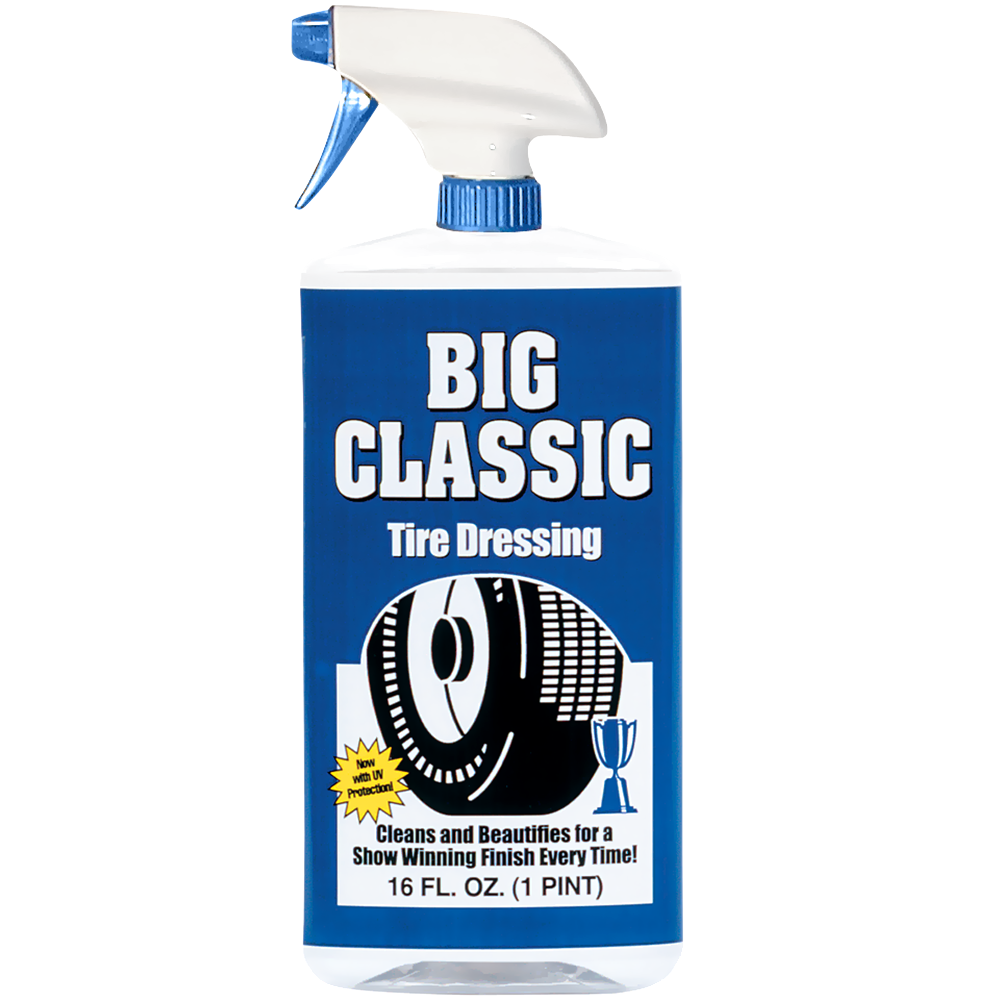
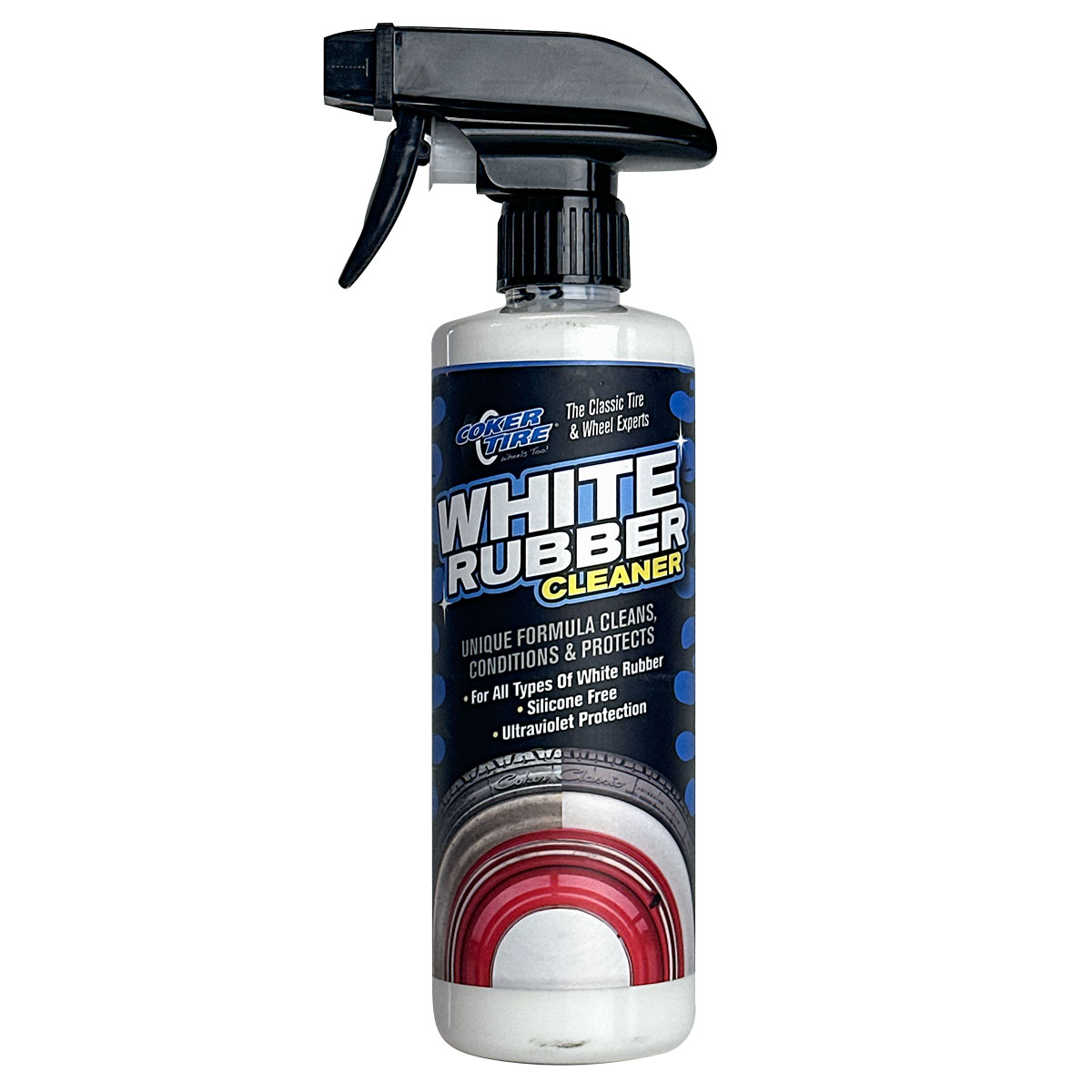
- Tire mounted on wheel for demonstration purposes only. Wheel and other accessories are not included. Please note that dimensions listed (tread width, section width and overall diameter) are non-scientific and based on an inflated tire, mounted to a wheel. Dimensions may vary due to rim width and inflation pressure. Please note Chemical Guys Tire and Rubber Cleaner and Adams Polish Tire shine has been linked to Whitewall browning and should not be used. We recommend using our line of tire care products.
| SKU | 55673 |
|---|---|
| Weight | 17.000000 |
| GTIN | 00842199101492 |
| Availability Date | 2026-10-30T00:00:00Z |
| Sidewall Style | Narrow Whitewall |
| Whitewall Width (in) | 1.000 |
| Tire Construction | Bias Ply |
| Construction Ply | 4 PLY POLY |
| Tire Series | US Royal Classic Bias Ply |
| Rim Diameter | 15 inch |
| Tube Type or Tubeless | Tubeless |
| Product Size | 560-15 |
| Tread Depth (32nds) | 12 |
| Tread Width (IN) | 3.75 |
| Width Bias Ply | 5.60 |
| Brand | US Royal |
| Max Load Capacity (LBS) | 970@32 psi |
| Section Width (IN) | 4.80 |
| Rim Width (in) | 4.50 - 5.50 |
| Overall Diameter (IN) | 25.88 |
This US Royal 1.00 Inch Whitewall comes in the 560-15 size, suitable for the classic and collector vehicles listed below.
About the 560-15 Tire Size
The 560-15 is a vintage tire size associated with a broad range of imported vehicle applications from 1950 through 1974, including models from MG, Volkswagen, Saab, Morgan, Hillman, and several other makes. This US Royal 1.00 Inch Whitewall is offered in that 560-15 size and combines a bias ply construction with a 1.00 inch whitewall appearance that suits period-correct fitment needs. For more detailed information on this tire size, explore the 560-15 tire on Coker Tire Fitment Guide.
560-15 Tire Size Alternatives
| Alternative Type | Tire Size | More Information | Products |
|---|---|---|---|
| Modern Radial Equivalent | 155R15 | 155R15 Tire Fitment Guide | 155R15 Products for Sale |
| Modern Radial Equivalent | 560R15 | 560R15 Tire Fitment Guide | 560R15 Products for Sale |
Vehicle Fitment for the US Royal 1.00 Inch Whitewall | 560-15
The US Royal 1.00 Inch Whitewall | 560-15 is available in a tire size associated with a range of classic and collector vehicles. The vehicle applications below are organized by year, make, and model to help identify vehicles associated with the 560-15 size. Explore the linked Make & Model and Year Make & Model pages for more detailed fitment information.
Fitment information should be verified for the specific vehicle before purchase. Confirm tire size, wheel fit, load requirements, overall diameter, and available clearance.
1950–195511 makes · 34 fitments
The 1950–1955 period includes a broad mix of 560-15 applications across Austin, DKW, Lancia, MG, Morris, Opel, Porsche, Vauxhall, Volkswagen, and other imported makes. These vehicle applications show the early reach of the 560-15 size across sports cars, sedans, and compact models.
MG
MG applications in this period include the MG and MGA.
Opel
Opel fitment in this period is represented by the Olympia.
Vauxhall
Vauxhall fitment in this period is represented by the Wyveren.
DKW
DKW applications in this period include the F89, Sonderklasse, and F91.
Lancia
Lancia fitment in this period is represented by the Appia.
Volkswagen
Volkswagen applications in this period include the Beetle.
Austin
Austin applications in this period include the A 40 and A 50.
Morris
Morris fitment in this period is represented by the Crowley.
Porsche
Porsche fitment in this period is represented by the 356 A.
Morris
Morris fitment in this period is represented by the Crowley.
Porsche
Porsche fitment in this period is represented by the 356 A.
1956–196011 makes · 56 fitments
The 1956–1960 period shows especially broad 560-15 coverage across British and European makes including Austin, MG, Morgan, Morris, Porsche, Singer, Sunbeam, Vauxhall, Volkswagen, and others. Applications in this range span a wide variety of compact passenger cars and sports cars associated with the 560-15 size.
Austin
Austin applications in this period include the A 40 and A 50.
MG
MG applications in this period include the MG and MGA.
Morris
Morris applications in this period include the Crowley and Oxford.
Porsche
Porsche fitment in this period is represented by the 356 A.
Vauxhall
Vauxhall fitment in this period is represented by the Wyveren.
Volkswagen
Volkswagen applications in this period include the Beetle and Karmann Ghia.
Morgan
Morgan applications in this period include the 4-4 Series & Plus 4, 4-4 Series, and Plus 4.
Singer
Singer fitment in this period is represented by the Gazelle.
Sunbeam
Sunbeam fitment in this period is represented by the Rapier.
Wolseley
Wolseley fitment in this period is represented by the 15/50.
Hillman
Hillman applications in this period include the Husky and Minx II.
Fairthorpe
Fairthorpe fitment in this period is represented by the Electron.
1961–196510 makes · 50 fitments
The 1961–1965 period continues the wide application range of the 560-15 size across Alfa Romeo, Fiat, Hillman, MG, Morgan, Saab, Singer, Sunbeam, and Volkswagen. This range reflects continued use of the 560-15 size on compact European cars and sports cars through the mid-1960s.
Fairthorpe
Fairthorpe fitment in this period is represented by the Electron.
Hillman
Hillman applications in this period include the Husky and Minx II.
MG
MG applications in this period include the MG and MGA.
Morgan
Morgan applications in this period include the 4-4 Series and Plus 4.
Saab
Saab fitment in this period is represented by the Saab 96.
Singer
Singer fitment in this period is represented by the Gazelle.
Sunbeam
Sunbeam fitment in this period is represented by the Rapier.
Volkswagen
Volkswagen applications in this period include the Beetle and Karmann Ghia.
Alfa Romeo
Alfa Romeo fitment in this period is represented by the 1600.
Fiat
Fiat fitment in this period is represented by the 1600.
Frequently Asked Questions
Fitment & Compatibility ▼
Will the US Royal 1.00 Inch Whitewall 560-15 Bias Ply Tire fit my classic car if it originally used 5.60-15 tires? ▼
The US Royal 1.00 Inch Whitewall 560-15 Bias Ply Tire is intended for vehicles originally equipped with a 5.60-15 tire size. For restoration projects, matching the original tire size is one of the best ways to preserve factory appearance, ride height, steering geometry, and speedometer behavior. Owners of many small American cars, compact classics, and certain imported vehicles may find the 5.60-15 size aligns with original equipment specifications.
Before purchasing, verify the original tire size listed in your owner's manual, service literature, or factory documentation. Tire size alone is not the only consideration. Wheel diameter, wheel width, suspension modifications, and brake upgrades can all affect compatibility. Confirming the complete wheel and vehicle setup helps avoid clearance or fitment surprises during installation.
Is the US Royal 1.00 Inch Whitewall 560-15 Bias Ply Tire suitable for original restoration projects? ▼
The US Royal 1.00 Inch Whitewall 560-15 Bias Ply Tire is specifically positioned toward restoration-minded enthusiasts seeking period-correct appearance. The tire uses authentic bias ply construction and a narrow whitewall design that reflects styling trends common during the transition from wide whitewalls to narrower sidewall treatments in the early 1960s.
Because the tire is produced from original molds and retains vintage construction characteristics, it supports restoration goals beyond simple visual similarity. Owners pursuing factory-style presentations, judged shows, or historically accurate builds often prefer bias ply tires because they replicate the appearance and driving character associated with original equipment applications from the era.
Will the US Royal 1.00 Inch Whitewall 560-15 Bias Ply Tire work well on a modified hot rod or custom build? ▼
The US Royal 1.00 Inch Whitewall 560-15 Bias Ply Tire can be appropriate for traditional hot rods and period-inspired custom builds that prioritize vintage styling. Its narrow whitewall appearance and bias ply construction complement vehicles seeking an authentic mid-century look rather than a modern performance-oriented appearance.
Compatibility depends heavily on wheel width, suspension geometry, ride height, and intended use. Many custom vehicles have significantly different alignment settings and weight distribution compared with stock applications. Builders should confirm clearance, stance goals, and overall tire dimensions before purchase. The tire is generally best suited for projects emphasizing traditional aesthetics rather than maximum cornering grip or modern handling performance.
Tire Size Equivalents & Conversions ▼
Can the US Royal 1.00 Inch Whitewall 560-15 Bias Ply Tire replace a worn original 5.60-15 tire? ▼
Yes. The US Royal 1.00 Inch Whitewall 560-15 Bias Ply Tire is intended as a replacement for original 5.60-15 applications. Owners seeking to maintain factory-correct appearance often choose the same size designation to preserve ride height, visual proportions, steering response, and overall authenticity.
Replacing an original tire with the same size also helps minimize unexpected changes in vehicle behavior. While aging original tires may have worn dimensions, the replacement tire should generally restore the vehicle closer to its intended specifications. It remains important to confirm wheel condition, wheel width, and overall vehicle setup before installation to ensure proper fitment and performance.
Is there a direct modern metric equivalent to the US Royal 1.00 Inch Whitewall 560-15 Bias Ply Tire? ▼
There is not always a single exact metric equivalent for a vintage bias ply tire. Modern radial sizing systems use different measurement standards, construction methods, and aspect ratio conventions. As a result, several metric sizes may appear similar while producing different overall dimensions once mounted.
When comparing alternatives, enthusiasts typically evaluate overall diameter, section width, and intended vehicle use. Matching appearance can be just as important as matching dimensions on restoration projects. Because the US Royal 1.00 Inch Whitewall 560-15 Bias Ply Tire is designed around historical specifications, direct metric substitutions may alter ride height, sidewall profile, and visual authenticity even if the measurements appear close.
Will switching to the US Royal 1.00 Inch Whitewall 560-15 Bias Ply Tire change steering feel compared with larger tire sizes? ▼
The US Royal 1.00 Inch Whitewall 560-15 Bias Ply Tire generally maintains the steering characteristics associated with its original size class. Compared with wider replacement tires, a narrower tire often reduces steering effort, particularly on vehicles without power steering.
Section width influences the tire's contact patch and the amount of rubber interacting with the road surface. Wider tires can increase steering weight and may place greater loads on vintage steering systems. Owners returning from oversized modern replacements to the original 5.60-15 size frequently notice steering that feels lighter and more consistent with period driving expectations.
Performance & Use Case ▼
How will the US Royal 1.00 Inch Whitewall 560-15 Bias Ply Tire drive on modern highways? ▼
The US Royal 1.00 Inch Whitewall 560-15 Bias Ply Tire delivers the driving character expected from an authentic vintage bias ply tire. Compared with modern radial tires, drivers may notice more steering input is required to keep the vehicle tracking straight, especially on highways with grooves, pavement seams, or worn surfaces. This behavior is normal and reflects the construction methods used during the period when bias ply tires were original equipment.
For owners seeking an authentic restoration experience, the highway behavior is often considered part of the vehicle's original personality. The tire is suitable for normal cruising and collector vehicle use, but buyers should not expect the same straight-line stability, lane-centering feel, or high-speed confidence typically associated with modern radial construction.
Is the US Royal 1.00 Inch Whitewall 560-15 Bias Ply Tire a good choice for regular weekend driving? ▼
The US Royal 1.00 Inch Whitewall 560-15 Bias Ply Tire is well suited for collector vehicles that are driven regularly on weekends, cruise nights, local events, and scenic drives. Its authentic appearance and period-correct construction make it particularly appealing for owners who want their vehicle to look and feel similar to its original factory configuration.
Drivers should understand that bias ply tires prioritize authenticity over modern handling performance. Ride quality, steering response, and road feedback differ from contemporary tires. For enthusiasts who value originality and historical accuracy, the driving experience remains enjoyable. For buyers seeking maximum comfort and modern road manners, a radial alternative may be worth considering.
How does the US Royal 1.00 Inch Whitewall 560-15 Bias Ply Tire affect steering feel compared with modern radial tires? ▼
The US Royal 1.00 Inch Whitewall 560-15 Bias Ply Tire provides a steering feel that is noticeably different from modern radial tires. Bias ply construction tends to generate more road feedback and may require more frequent steering corrections as road conditions change. Drivers often describe the experience as more connected to the character of the vehicle's original era.
The narrower contact patch and flexible tread behavior can also influence directional stability. While steering effort may remain relatively light due to the tire's size, the vehicle may not feel as planted at higher speeds as it would with a modern radial tire. Enthusiasts pursuing authenticity generally consider this a normal and expected characteristic.
Construction, Durability & Load Capacity ▼
What are the benefits of the bias ply construction used in the US Royal 1.00 Inch Whitewall 560-15 Bias Ply Tire? ▼
The US Royal 1.00 Inch Whitewall 560-15 Bias Ply Tire uses traditional bias ply construction, where the internal cords run diagonally across the tire and overlap in a crisscross pattern. This design reflects the construction methods used on passenger cars and light trucks for much of the twentieth century. For restoration enthusiasts, the primary benefit is authenticity, as the tire looks and behaves much like the original equipment found on vintage vehicles.
Bias ply construction also contributes to the period-correct driving experience many collectors seek. The tire's structure provides a distinctive steering feel and road response that differs from modern radials. Buyers focused on originality, show presentation, and historically accurate restoration often consider bias ply construction an important part of the vehicle's overall character.
How sensitive is the US Royal 1.00 Inch Whitewall 560-15 Bias Ply Tire to inflation pressure changes? ▼
The US Royal 1.00 Inch Whitewall 560-15 Bias Ply Tire can be more sensitive to inflation pressure changes than some drivers expect. Inflation pressure influences tread contact, steering feel, ride quality, and how the tire responds to road surfaces. Even relatively small pressure variations can affect how a bias ply tire behaves.
Maintaining the vehicle manufacturer's recommended pressure or an application-specific pressure recommendation is important for achieving predictable handling and wear patterns. Underinflation may increase heat generation and steering response issues, while excessive inflation can alter ride characteristics and tread contact. Regular pressure checks are among the simplest and most effective ways to maintain consistent performance.
Why do restoration enthusiasts choose the US Royal 1.00 Inch Whitewall 560-15 Bias Ply Tire instead of a modern radial alternative? ▼
Many restoration enthusiasts choose the US Royal 1.00 Inch Whitewall 560-15 Bias Ply Tire because it closely replicates the appearance and driving character associated with original factory equipment. The authentic bias ply construction and narrow whitewall styling help create a historically accurate presentation that is difficult to duplicate with modern tire designs.
Beyond appearance, the tire preserves the period-correct experience behind the wheel. Steering feel, road feedback, and overall vehicle behavior remain closer to what owners would have experienced when the vehicle was new. For collectors focused on authenticity rather than modern performance optimization, maintaining these original characteristics is often a primary goal of the restoration process.
Installation & Maintenance ▼
What should I verify before installing the US Royal 1.00 Inch Whitewall 560-15 Bias Ply Tire? ▼
Before installing the US Royal 1.00 Inch Whitewall 560-15 Bias Ply Tire, verify that your vehicle uses a 15-inch wheel and that the 5.60-15 size is appropriate for the application. It is also important to inspect wheel condition, wheel width, valve stems, and overall suspension health before mounting new tires.
Buyers should additionally check for clearance around fenders, steering components, and suspension parts, especially if the vehicle has been modified. Confirming alignment condition before installation can help promote even wear and predictable handling. Addressing these items beforehand reduces the likelihood of fitment issues and helps the tire perform as intended from the start.
Write Your Own Review
OTHER STUFF YOU MAY LIKE
Check items to add to the cart or

Popular Add-Ons For Your Order
More Tires This Size